In 1881 Rayno Sciocatti’s Italian ancestors were brought out by the Cape Government to start a silk industry in Gouna – about 14 miles northwest of Knysna and over 900 meters above sea level. The immigrants were farming people of substance from the Mountainous area of Trevino in Northern Italy .
There were 32 in the group – three families and a few single men – all silkworm breeders and specialists from the silk- producing districts of Northern Italy. Their names included Fardini, Polonia, Sciocatti, Tornes and Caccias – amongst others. They had been lured by an invitation from Henry Barrington – an English gentleman farmer to start a silk industry near Knysna. There were a lot of wars going on in Italy at the time, and economic hardship and many people were tempted to seek their fortunes elsewhere.
When the families arrived to board their ship, they found it was too small to hold all their furniture as well as their possessions. Each family was given a trunk which contained only essential items like shoes, clothes and cutlery. Everything else was left on the quayside. They eventually sailed from Genoa on 25th March 1881 – arriving in Knysna via Cape Town six weeks later. They did not speak a word of English and travelled with an Englishman called William Christie who acted as guide and interpreter .
Many of their names were incorrectly recorded during the journey and different versions remain in use. This made the tracing of the families back in Italy quite difficult.
One of Dalene Matthee’s books, The Mulberry Forest, tells the story of a group of Italian silk farmers who were brought to Knysna to farm with silkworms and start up a silk spinning industry. They were settled at Gouna in a forest clearing occupied by a headstrong Silas Miggel and his daughter. When it was clear the Italians were not coping, the father and daughter came to their rescue. The daughter because she cared and Silas because he wanted them off his land and back on board a ship heading back to Italy.
When Dalene Matthee wrote her book, she went to Italy. She could not even find the Sciocatti surname. So many variations exist. The book depicts the Italian immigrants as much poorer than they were in reality. When the Italians finally arrived in Knysna on the SS Natal, they were housed in tents in Belvidere. After some weeks, they were sent into the Gouna forest – some on foot and others in ox wagons and ox-drawn sledges carrying all their possessions. They were under the impression that they would get land, houses, mulberry trees and a living wage. All they would need to bring with them was their silkworms and their skill as spinners. They had expected to find established mulberry plantations so that all they needed to do was pick up the cocoons and weave their silk. When they reached their destination, after three weeks of travelling through the forests and up the hillsides with the oxen moaning and the wagons creaking, they found themselves in the middle of nowhere. They were faced with a waste tract of land backing onto a wall of jungle in which elephants, buffalo and baboons roamed freely. However it was very beautiful and reminded them of the Italian hills they had left behind. Not a mulberry tree was to be seen or even a shed for their precious silkworms.
The Government had supplied some implements, tents and an ox-drawn plough. For the first six months they subsisted on government rations. The mulberry trees the Italians planted grew to about a metre and then died once their roots penetrated the shallow good soil and reached the clay beneath. Dreams of a silk industry had to be abandoned, and they were forced to eke out a meagre existence as small-scale farmers and woodcutters.
They were Roman Catholics and had left behind in their village in Italy a 1200-year-old church where generations of their families had been christened, married and buried. Imagine the shock of arriving in Knysna with not even a house or a church and no sheds to store their precious silkworms. Life was very hard for them. Because of their dark skin colour and foreign language, they were regarded with suspicion by existing settlers.
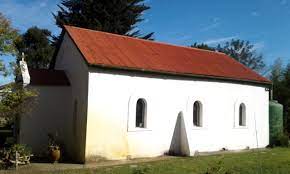
They were urged to learn to speak Afrikaans and attend church in Knysna. The San Ambroso chapel still standing in Gouna was eventually built for them by Rev Rooney in 1891 – ten years after they arrived. It’s a tiny church – with just four pews on either side of a central nave. There is a brightly painted fresco on the back wall. Two rooms at the rear of the church act as a museum. They are filled with portraits, press cuttings, photographs, implements and memorabilia. Rayno Sciocatti has lived in the area for much of his life. Rayno Sciocatti’s uncle would cut logs and take them to
Thesen’s and his father worked at Thesens as an auditor. They were very frugal and eventually managed to buy a lot of the land which is still owned by the Sciocatti family. When Rayno sold his farm he always intended to buy land in Tsitsikamma – but found himself drawn to Gouna and decided to renovate the church that held so many memories for his forefathers. A hippy family had been living in it. After they were evicted, he found the floors had been ruined and the yellowwood ceiling planks stolen. It had been vandalised over the years and the original valuables looted.
Everything had to be restored. The cost of restoring the building alone was R600 000, not counting the furnishings. When Thesen Island was being built, the old fire station was broken down and Rayno got hold of the Oregon pine in the roof and rebuilt the ceiling in the chapel. He recalls his dismay when a painter misunderstood his instructions and painted the pine white. He retrieved some yellowwood flooring and frames and the chapel was opened to the public about 14 years ago. The renovation is ongoing and people are encouraged to visit the church. Entry is free but donations are very welcome.
In 1969 When I was a student at UCT there were other students who shared our cafeteria. There was one striking girl. Six foot tall, slim very pretty with red hair and wore a hippy dress down to the ground
This was Rosalind Ballingall, studying for BA drama, second year, 20 years old.
She was part of the “Cosmic Butterfly” group of hippies. Some say they were involved in drugs, spirituality and orgies etc.
Us Architecture students were a down to earth bunch so we did not chat up these Hippy chicks, so I never spoke to her.
In 1969 she and two friends came to Fisanthoek,, next to the Garden of Eden for a long weekend break. They stayed at “Sugar House” a Hippy Commune.
The story goes that she took a bible, went for a walk in the forest, and was never seen again.
Later when I moved to Plett I got interested in the whole matter as I was one of the only people who knew what she looked like. I spoke to many locals about it but they did not know too much.
In 2005 Nicole Schafer, a student at UCT made a DVD documentary for her Masters in film and TV production, called “The Ballad of Rosalind Ballingall”.
She did a huge amount of research on the whole matter.
Here is her documentary DVD ( from UCT Archives)
These were the days of the Hippies, drugs, anti-Vietnam protests, major restricted censorship under Apartheid, Joan Baez and Bob Dylan.
There are some things that I found strange.
Rosalind was part of the Cosmic Butterfly group of Hippies who were into spirituality etc. It is strange that she would take a bible and go for a walk?
Nicole tracked Rosalind brother and sisters in the UK and they would say nothing. She also tracked those who were there and they too would say nothing. She also contacted the original owners of Sugar House but they would also say nothing.
The Police file on the matter has gone missing
Rosalind was only reported missing 24 hours after disappearing why did they take so long to report it?
While everyone was searching in the forest for Rosalind, her boyfriend sat on the stoep at Sugar House and played his flute!
Rosalind’s dad was an executive at Rand Mines in Johannesburg so very rich and came to Plett to help in the huge search that was done. According to a report in the Press, Rosalind’s Dad believed that her boyfriend had made her pregnant and then murdered her.
Also in 1986 the Cape Town High Court confirmed that Rosalind was declared dead so that a life policy could be paid out?
In 1986 a body was found at Fisanthoek.. On investigation it was found that it was a female between 45 and 60 years old but only 1.5 m tall so it was not Rosalind.
One weekend I Googled Rosalind and found a 2 year old mail from a lady in the UK who wanted to see Nicole’s DVD. I sent her a copy. I then asked why well after 40 years she was interested. She replied.
“My boyfriend and I were driving from PE To Knysna. In those days there was hardly any traffic on the road. Just an endless road and trees. Before we got to the big tree we saw a couple walking down the road with no backpacks or even a bag. Like they were taking a stroll in a park. It was weird. Both were tall and slim, one with long blond hair and the other with short reddish brown hair. So cool.
We spent the night in Knysna and then went to Cape Town.
We read that Rosalind had gone missing in the local press. We were going to report the matter to the police but in a later press it stated that Rosalind was seen at the George Post Office so we didn’t worry. I then got a letter from Rosalind’s mom who tracked me via the Knysna hotel and asked if we had seen anything on the road. I told her what we saw and all I got was “Thank you” in response. The next press release said that the sighting in the George Post office was a mistake.
I am convinced that it was Rosalind we saw on the road.
No follow-up or search was done on the road.
One day a local accountant, a down to earth guy who believes in nothing, was on his way to Knysna. As he entered the Garden of Eden the hair on the back of his neck stood up as realised that there was someone sitting behind him in the car! He nearly wet himself. He kept driving and when he exited the Garden of Eden the person was gone.
Also, the family of a local dentist were on their way to Plett. On entering the Garden of Eden their son in the back seat started screaming. The parents were shocked and asked what was wrong. Their son said that a lady was sitting next to him in the car.
I wrote an article in the CX Press asking if it was perhaps Rosalind?
I was then contacted by a guy from the UK who had read the article. He told me that he grew up with Rosalind. He had written a book about growing up together. He emailed it to me 350 pages. (Guess what? He went to school with the husband of the lady who contacted me from the UK.)
He also told me that he knew a lady who knew Rosalind, who said that she knew what happened to her. They had some drinks in JHB and she got drunk and told him nothing. I tracked the lady down. I asked her to tell me what happened.
Her reply was, “should I tell you what happened the same will happen to me”
Then to the various stories
There were so many rumours going around that she was seen in Long St Cape Town, in Durban and even in Kenya but nothing was ever proved.
Then there was a story that there was a love triangle.
Perhaps with drugs things went wrong and she was killed. That’s it.
So if you are travelling to Knysna and someone joins you in the car do not be afraid as it may be Rosalind, a lost spirit looking for closure.
Sophy or Sophia Gray was a multi-faceted person who happened to be a woman. It would be easy to talk about her and her achievements for a long time.
What I would like to do is to talk about the person and to put her in the context of the time in which she lived and worked, the work she did, and the efforts involved.
In this talk the elements will be
The person
The time
Her work
Sophy Gray, the person.
Youth
Born on 5th January 1814, five years before Queen Victoria and more than 20 years before the Victoria era began.
Let’s ponder that for a moment – more than 202 years ago.
During the first twenty years of her life, slavery was acceptable – and a source of wealth to many families.
Can we begin to think what Keurbooms looked like then.
No Angling Club I am sure.
She was the 5th daughter of country squire Richard Wharton Myddleton of Durham and Yorkshire and grew up as a member of an affluent family. They were all well-read and proficient horse riders from an early age.
Married
In 1846, at the age of 22 after a 6-month engagement, she married Robert Gray, the rector of Whitworth, Durham.
They lived at Old Park and Whitworth, all the time involving themselves in the spreading of Christianity and civilization, as they saw it – and in the ecclesiastical church movement.
Robert developed strong feelings about church architecture,many Sophy began to make drawings of architecture in a sketchbook.
Robert Gray regarded churches with white walls as hideous and despised church buildings with rounded windows.
ORGANISER
From the start
In 1847, Robert was chosen as Bishop of the Cape of Good Hope bishopric, and on 29th June 1847, in Westminster Abbey, he was consecrated the first bishop of South Africa. His diocese included the whole Cape Colony, the Orange Free State, Natal, Tristan da Cunha and St Helena.
After the Bishop’s consecration, he and Sophy planned, within a few days, the requirements of a new diocese in terms of clergy finance and equipment.
They considered Cape Town and Grahamstown and decided in favour of Cape Town.
Before departure
The time between his consecration and his departure was spent in raising funds for his diocese. He was a formidable fundraiser and it is estimated that he collected £130 000 for his diocese during his lifetime.
If we use the equation of Martin Meredith, that would equate to some £13 million today.
A very heavy burden fell on his wife, Sophy. Within days, she planned the requirements of the new diocese in terms of clergy, finance and equipment. She had to prepare for a Bishop’s residence and for everything they might need for years in far off Africa. She hired a retinue of servants, purchased furniture for an unknown residence and even obtained an episcopal carriage.
Sophy spent her days with pen in hand, copying correspondence and other documents.
But what she also did, was to visit churches and make sketches of every detail of church architecture.
She also painted numerous water colours – and frequently illustrated her husband’s journals.
At departure
On the 20th of December 1847, they set sail from Portsmouth on a little ship – open-decked and exposed to the elements.
It was hardly in motion before Sohpy unpacked her boxes and was bent over ledgers and papers.
They arrived in Cape Town on 20th February 1848 after 8 weeks at sea.
At the Cape
in Cape Town, the couple settled on the farm Boschheuwel, which originally belonged to Jan van Riebeeck.
It was subsequently named Wijnberg and then Bishopscourt.
Soon after their arrival, the organizing of the first synodical meeting at Cape Town fell on Sophy’s shoulders. . Nine clergy and their attendants had to be fed and accommodated in her home.
The Bishop immediately started visitations to outlying parts of his diocese. She arranged all visitations for the Bishop. While he was travelling, she wrote to him constantly, carried out all his instructions and copied his correspondence.
A few years after their arrival, the Cape Diocese became an efficient and smooth-running organisation.
NURSE
In addition to her time-consuming and extensive administrative duties, Sophy took responsibility for nursing her husband. He suffered from a variety of chronic conditions – one of which is described as
“Agonising from behind his forehead, beating into his brain. He was feeling faintness, chilliness and nausea” . His physician diagnosed it as “rheumatism in the head” (but it was probably migrainous neuralgia).
The doctor bled him profusely without success. He tried Iodide of Potassium for pain and Bawley’s Sedative Solution to make him sleep.
Sophy wrote: “The Bishop is suffering from a severe attack of illness which entirely prevented him from attending to any business. “
He was a highly psychosomatic case.
Sophy had no time or opportunity to recover from her sleepless duties of caring for the Bishop and facilitating diocesan affairs. The Bishop wrote that she “has been much tried in nursing me for so long a time”.
Traveller
The Bishop’s diocese was extensive. He embarked on a series of visitations almost immediately and was accompanied by his wife on almost all of them.
They travelled under harsh and sometimes dangerous conditions over very long distances.
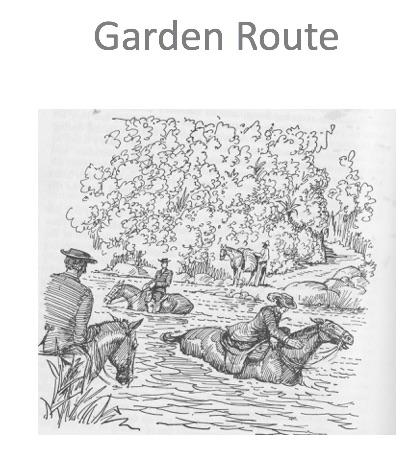
Roads on the Garden Route were impassable by cart and they always rode. There she experienced “steep, slippery trails, dripping forests and flooded rivers”.
In other areas she and the Bishop walked over hundreds of miles.
One of these fearful journeys was from Klaarstroom to Beaufort West. They drove through dreary landscape for 100 miles to Victoria (West) and had to overnight in a room shared with a hen and chickens in a deserted farmhouse. They reached Beaufort West on that occasion after 1 000 miles on the road.
Sometimes, especially at George, the heavens opened up on them.
Her horsemanship was regarded as better than that of the Bishop – and indeed that of any man. But it was excruciatingly exhausting.
Everywhere she travelled, plans were started for church buildings.
Architect: Her Church Buildings
On his visitations, the Bishop implored communities to start with the construction of churches and promised that he would furnish plans and working drawings. He was a formidable fund raiser and it is estimated that he succeeded in raising about £130 000, at a time when a decent little church could be built for around £1 000. They were a formidable team and the number of Anglican churches in SA rose from ten, at the time of their arrival in 1848, to around 50 by 1871, when Sophy died.
It was the time of the Gothic Revival style in England and the style was favoured for all ecclesiastical buildings.
This emerged from Gothic architecture in the 18th and 19th centuries
Gothic architecture which emerged in 12th and 13th centuries broke with the architecture of Constantinople and Northern Italy, and was characterized by ribbed vaults, flying buttresses and pointed arches which enabled very tall structures with as much natural light as possible –and large stained glass windows.
One of the earliest buildings in this style was the Carolinian Church of St Denis in Ile de France.
New Gothic or Gothic Revival architecture was characterized by steep pitched roofs, buttresses, and lancet windows. It flourished in 18th century England. The industrial revolution meant that new materials were available and this coincided with a deep philosophical and religious revival. The driving force of the Empire at the time was a combination of Commerce, Christianity and Civilisation.
There were three types of New Gothic: Early English, Decorated and Perpendicular.
Finances dictated that most churches in South Africa be built in the cheapest of these, the Early English.
The Bishop did not approve of brick for church building but preferred stone. He believed that plastering of walls disfigured a church. Round-headed windows in a church were regarded by him as hideous.
When the Sophy and the Bishop arrived in South Africa, there were only 10 Anglican churches. By the time he died 25 years later, there were more than 60.
Sophie Gray prepared sketches and working drawings for at least 40 churches.
Some of her church buildings are:
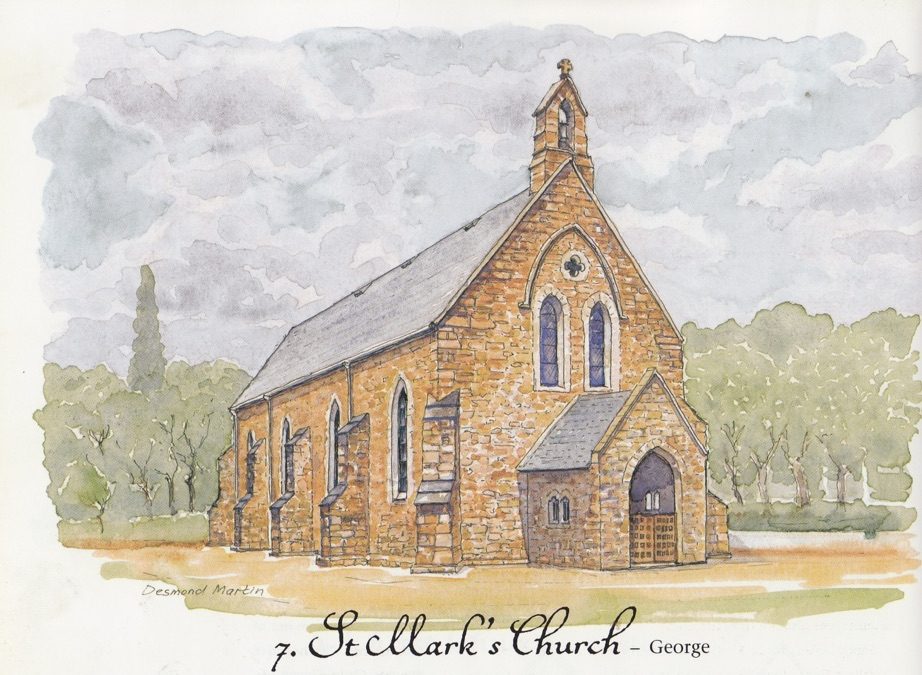
St Mark’s, George
During his first visitation to George in 1848, the Bishop met with church members in the local court house and a plan by Sophy Gray was accepted. She laid the foundation stone on 23 October 1849 (should have been 22 October). It was consecrated by Bishop Gray on 7 December 1850. Too small in ten years time and much has been added onto it.
St Paul’s, Rondebosch
There was a church on the site (since 1832) but it was too small. The Bishop offered a plan in the Decorated New Gothic style for its extension. The foundation stone was laid on 20 February 1849. The plan is thought to be a design by the British architect Butterfield, modified by Sophy.
St Peter’s Plettenberg Bay
William Newdigate was the chief driving force behind the building of a church at Plettenberg Bay. Bishop Gray met him on his first visit in 1848. Newdigate financed the first wooden church but it became too small and dilapidated. Sophy Gray provided a plan and the church was built between 1878 and 1881.
St George’s, Knysna
The Bishop initiated the building of a church in 1848 and provided a plan by his wife. Building started in 1849 on land provided by George Rex but stopped, due to a shortage of funds. During a visit in 1850, the Bishop was very pleased to see that a very fine stone for building had been found. “The church is a decorated building copied from an ancient English church and is intended to be the chancel of a larger edifice”.
It was consecrated on 3 October 1855.
St Matthew’s, Riversdale
The Bishop visited Riversdale in 1848 and initiated steps to have a church built. The DR Church gave the church a plot and a plan by Sophy was accepted. The cornerstone was laid on 22 November 1854 and the building was consecrated two years later on 22 November 1856.
All Saints, Uniondale
The Bishop obtained an erf there in 1869 and a plan by his wife was accepted. She passed on in 1871 and the Bishop in 1872. They never saw the church completed. It was opened for use in 1876.
St Paul’s, Port Elizabeth
Sophy Gray designed the church but her plans were not correctly executed. The Bishop consecrated the church on 30 August 1856. A tower and spire were added twelve years later. It was demolished in 1959.
St Thomas Mission Church, Rondebosch
Sophy Gray provide plans and it was built in 1864 and 1865. Although originally only a small thatched chapel, it had distinct features. It was enlarged in 1903.
St John the Baptist, Schoonberg
Peregrine Bertie Richardson made land available and Sophy provided plans for a church building at Schoonberg. The newly built stone church was taken into use in 1854 and in 1855 the Bishop travelled to Schoonberg to consecrate it.
The Bishop noted in his journal on 13 October 1855: …exceedingly well built early English church and very neatly and correctly fitted up.
It was built altogether according to Sophy’s plans. It was damaged by fire and rebuilt with some additions and modifications.
Holy Trinity, Belvidere
Unique in the sense that it is Sophy Gray’s only Norman design in SA. This design predated by about 200 years the 3 Gothic styles of Europe popular from 1140 to in the 1500s.
Bishop Gray visited the site and got the ball rolling in 1848, it was opened for service in 1853 and was consecrated on 5 October 1855.
St Saviours, Claremont
The foundation stone was laid in November 1850, it was opened for services in March 1853, consecrated on 18 April 1854 and completed in 1880. Both Sophy and the Bishop are commemorated in the church and in St George’s Cathedral.
St Peter’s, Cradock
It was initiated during the Bishop’s visit of 1848 when he promised:
“My wife will furnish you with plans and working drawings for your church if you will tell her how many you want it to contain”.
Holy Trinity Church, Caledon
Initiated during Bishop’s 1848 visit, consecrated August 1855.
Armstrong Memorial, Grahamstown
It was initiated as a memorial out of grief for the untimely death of the first Bishop of Grahamstown. He died of tuberculosis on 16 May 1856, less than two years after he and his family arrived in Grahamstown and was buried next to his baby daughter Ruth. After his death funds for a memorial chapel streamed in from near and far and in 1859 this memorial was built over the graves of Bishop Armstrong and his little daughter. Bishop Gray and his wife Sophy travelled to Port Elizabeth by sea and she provided a plan for the memorial chapel. It is thought that an original design by Henry Woodyer of London, a pupil of William Butterfield, was modified by her. Building commenced in December 1856 but soon came to a halt. A second builder moved onto the site but proved worse than the first. A third contractor finished the building but soon ongoing repairs caused concern. In 1869 Bishop Cotterill described it as too ruinous to restore and urged it to be taken down. It died a slow death from neglect and vandalism until its demolition in 1950.
Sophy Gray died aged 57 at Bishopscourt, Cape Town on 27th April 1871.
She was buried in St Saviours churchyard, Claremont.
Her husband died the following year on 1st September 1872 aged 62.
Additional reading:
Desmond Martin – The Bishop’s Churches. ISBN 978-1-77007-155-1
I was born in Naples, Southern Italy and I am quite passionate about the culture and the history of this beautiful part of the world. The purpose of my talk is to share with you some facts about the history of Southern Italy which may not be well known.
Let’ s start from the beginning. How many of you have heard of the Kingdom of the two Sicilies?
Let’s look at the map of pre-unification Italy
It consisted of eight different states:
The Kingdom of Sardinia (Piedmont – In Italian Piemonte) The Lombardo Veneto (Under Austrian rule) The Principality of Parma The Duchy of Modena The Grand Duchy of Tuscany The Republic of San Marino The Papal States The Kingdom of the Two Sicilies As you can see the Regno delle Due Sicilie (Kingdom of the two Sicilies) was the name given to Southern Italy before unification
The Kingdom was the largest and most populous state of pre-unity Italy
Why this rather odd name of Kingdom of the two Sicilies, when in fact there is only one Sicily?
Well, over the last one thousand years Southern Italy was ruled by various dynasties, Normans, French, Spanish and others. As the rulers changed, often boundaries were re-written. At one stage the whole of Southern Italy was known as the Kingdom of Sicily. Then the island of Sicily seceded and kept the name of Kingdom of Sicily, while the ruler of the mainland in his wisdom decided to keep his title of King of Sicily. When the island and the mainland were finally re-united, to avoid bruising egos the new entity was renamed the Kingdom of the two Sicilies.
This happened at the beginning of the eighteenth century. For the last 3 centuries prior to that Southern Italy had been ruled by Spain.
In 1734 one of the Spanish Princes, Carlo di Borbone,
managed to convince the Spanish government to relinquish the control of Southern Italy and he became the first monarch of the Neapolitan Bourbon dynasty (Borboni di Napoli) to rule over the Kingdom of the two Sicilies.
Map of the Kingdom of the two Sicilies
Flag of the Kingdom of the two Sicilies
Carlo di Borbone proved to be an exceptionally enlightened and talented monarch. Under his rule architecture, the arts, music, science, technology, commerce and industry flourished and the golden period of the history of the Kingdom of the two Sicilies began. Carlo di Borbone only ruled Southern Italy until 1756 when he was offered the crown of Spain and moved to Madrid as King of Spain, but his successors carried on his legacy.
Let’s go through some of the remarkable developments that took place under the Bourbon dynasty and that can be looked at as the GLORY of the Kingdom of the two Sicilies.
Although there were great achievements in most fields the following stand out as areas of excellence
Architecture
Caserta 1
He wished to build a new royal court and administrative centre for the kingdom in an inland location, protected from possible attacks from the sea , and away from the congested city of Naples.
The brief for this development on a 120 hectares site near Caserta, some 30 km inland from Naples, was given to the Dutch architect Lodewjik Van Wittel, whose name was soon Italianised to Luigi Vanvitelli
This statue of Vanvitelli stands in a piazza in Naples named after him
Construction began in 1752. We can see some of Vanvitelli’ s original plans
Plan 1 Plan 2
The grandiose palace and park are strikingly beautiful and elegant
The gardens expand along a waterfall
Adorned by many fountains and exquisite marble statuary.
The most impressive of these are
The fountain of Aeolus
Fountain of Aeolus
Close up
The Fountain of Venus and Adonis
Venus and Adonis
The Fountain of Diana depicting beautiful hunting scenes
Fountain of Diana
Fountain of Diana Close up
Close up of Diana)
The Fountain of the Dolphins
Fountain of the Dolphins
Fountain Margherita
Margherita
By the way nothing to do with Pizza Margherita.
Pizza Margherita
This is the real thing: thick crust, fresh tomatoes, basil and my friend Marco’s mozzarella. A yummy for Mother’s day.
The pizza Margherita came into being one hundred years later. It also had a royal connection. There was, and still is, a well known family owned pizzeria called “Brandi” near the royal palace of Naples. Legend has it that one day queen Margherita of Italy visited the restaurant. The owner, Mr. Brandi had just designed a new pizza which he offered to the Queen who thought it was excellent and from that day it was named MARGHERITA and is known as such throughout the world.
Getting back to Caserta, an enormous amount of water was required to feed all the fountains and the water courses. For this reason Vanvitelli had to build an aqueduct which was named after him
Aqueduct
Look at the elegance of the design, reminiscent of Roman aqueducts.
Let’s now look at the Royal Palace itself which was clearly inspired by the Palace of Versailles
Palace
The Palace is rectangular, with four large interior courtyards intersecting at right angles. It covers 45,000 m2 and its five storeys rise to a height of 36 m.
Aerial View of the Palace.
The building contains 1,200 rooms (this beats any house on Beachy Head)
The monumental main staircase
Staircase
gives access to the throne hall
Throne Hall
Another noteworthy feature is the Court Theatre, a superb example of 18th-century design.
Theatre
The royal apartments include a magnificent library
And, naturally, the royal bedroom
Royal Bedroom
As a matter of curiosity the royal bathroom included a bidet, the first ever to be installed in Italy
Bidet
And now let’s talk about
San Leucio
To compensate the farmers who had lost 120 hectares of land Carlo di Borbone decided to create a village on a nearby royal hunting reserve known as the San Leucio Resort, right next to the Royal Palace of Caserta. The village was designed to house a very advanced silk weaving industry. San Leucio was an unusual experiment well ahead of its time, combining the most advanced technology available with a modern social security system for the workers who had subsidised housing, free schooling and free medical care as well as participation in a profit sharing system. Not bad for the middle of the eighteenth century.
A United Front of Khoikhoin Gounaqua & Amagqunukhwebe
SPEAKER: Mike Kantey
Events leading up to the 19th Century
The first major driver behind the dispossession and fateful resistance of the indigenous and migrant African tribes of what became South Africa was the colonisation of the Southern Cape by first Dutch, French and German, and then later, British settlers.
The Plight of the Khoikhoi Herders
Once the dispossession of the Khoikhoin or “Hottentots” had been completed, some were employed by the Colonial authorities as foot-soldiers. First seen on the Eastern Frontier during the Van Jaarsveld rebellion in Graaff-Reinet in 1799, General Thomas Pakenham Vandeleur used them for scouting “… and was so pleased with their services that he soon requested a reinforcement of 50 more.” (1)
The Third Frontier War, which broke out in April 1799, complicated the situation for Vandeleur who disarmed all vagrant Hottentots at Algoa Bay. Some 300 of these eventually joined the Xhosas against the British. Peires et al describe the situation as follows (2):
… By 1795 there was not a single legally recognised free Khoi community west of the Fish River. Most Khoi lived as labourers on their old lands, now divided among the Boers, and even those who managed to maintain an independent existence in the remote corners of the frontier were insecure and without legal rights.
The Khoi saw their opportunity in 1799, when British troops arrived to fight the rebel Boers of Graaf-Reinet. They flocked to the British standard in the hope of getting their country back.
“Restore,” said Klaas Stuurman, “the country of which our fathers were despoiled by the Dutch and we have nothing more to ask.”
Peires et al (2) state that in September 1799, Acting Governor Dundas arrived to make separate peace with the Boers, the amaXhosa and the Khoi. They suggest that the terms of the Khoi peace shows clearly the Imperial view of the Khoi. While the amaXhosa were treated as an independent nation, the Khoi were regarded as rebellious subjects. They were declared to possess no landed property of their own and were therefore “expected to enter the service of the Colonists as they had done before.”
According to a delightful newsletter published in Richmond (3), Klaas Stuurman offered refuge in 1799 to drosters, escaped slaves, and those who had been forced into what was euphemistically called and “apprenticeship”. These renegades then unilaterally declared themselves as “Gounaqua” or “The Gamtoos Nation” and raided farms as far afield as Plettenberg Bay.
Enter the Amagqunukhwebe
The AmaGqunukhwebe were a sub-group of the amaXhosa created under the reign of King Tshiwo (1670-1702), who was a grandfather to Gcaleka and Rharhabe.
They were made up mostly of the Inqua, Gonaqua, Hoengeiqua, and others overrun by western amaXhosa pioneers and then incorporated into the Xhosa nation Khwane kaLungane, the son of Lungane ka-Depe, was a trusted counsellor and a great warrior of King Tshiwo. He was given leadership of this new chiefdom of amaGqunukhwebe, creating the Khwane dynasty. (4) Their land ran from the Buffalo (Qonce) to the Zwaartkops (Qhagqiwa) rivers, but most of it was lost as a result of the Frontier Wars and was mostly given to colony settlers (west of the Fish River) and amaMfengu (between the Fish and Keiskamma rivers) by the colonial government.
During the late 1780s, Ndlambe defeated the amaGqunukhwebe, inflicting heavy losses upon them. They were forced to retreat westwards towards the Langkloof under Chungwa. Because of their long association, the amaGqunukhwebe and Stuurman’s frontier raiders were natural allies.
When I was researching this story, I had nearly completed the research in the time allowed when – ironically – I found a perfectly set out version by Professor Andrew Duminy in a March 1986 edition of this very same VPHS Bulletin (5). Most of that which follows, therefore, will be drawn from that article.
Between 1789 and 1800, a large number of expeditions attempted unsuccessfully to ‘persuade’ the amaGqunukhwebe to remove themselves and to bring the Stuurmans under control. From 1789 to 1801, the renegades were able to raid at will throughout the frontier region and the massacre at de Poort was one of the consequences.
Apart from the incidents around Plettenberg Bay and Knysna, about 470 farms – about 35 percent of those registered in the Graaf-Reinet and Swellendam districts – were laid waste, while the colonists claimed to have lost 50,000 head of cattle; 50,000 sheep and 1,000 horses.
In August, 1802, Stuurman led 700 men, including 300 horsemen and 150 with firearms, against the Uniondale field cornet, Tjaart van der Walt. During a dawn raid on August 8, between the Baviaans and Kouga rivers, a stray bullet killed Van der Walt and he was buried where he fell. (3)
In October 1802 … a band of armed raiders, swept through the Bitou and Piesang River valleys and then westward towards Knysna, looting the farms and burning the homesteads. According to Duminy (5),
The most harrowing story was that of the de Poort murders, close to a spot which is now known as “The Garden of Eden”. Fearing for their lives, a group of farmers from the Piesang Valley had set off for Knysna, intent on seeking refuge in Cape Town.
“The party was led by Cornelis Botha and included his wife, his son and daughter-in-law with their young child, and two other farmers with their families. As they reached de Poort, they were ambushed. Botha escaped on horseback with two others and fled to the farm Stofpad near Wittedrif, where fortifications had been erected to provide shelter for the local inhabitants.
A letter dated 31 October 1802 from the Resident at Plettenberg Bay, P.J. Meeding, to General Dundas refers to “the necessity of abandoning post and embarking for Cape Town”.
In another letter of 15 November 1802, General Dundas writes to the Minister of War in London, with reference to Knysna pioneer James Callendar’s complaints of the raiders that it was “more consistent with the character of an English man, to take up his gun, join the commando, and show an example of spirit than writing alarming letters.
Meanwhile, according to Duminy (5), the survivors in the Southern Cape clustered around the only four fortified places that could provide protection: Stofpad in Plettenberg Bay; Algoa Bay (Fort Frederick); the Langkloof; and Scheeper’s Drift on the Oliphants River.
Chungwa set about building new headquarters in the Langkloof but divisions soon appeared among the allies, which were skilfully exploited by both the Batavian and British administrations over the following ten years. “Klaas Stuurman, for example was given a piece of land in Baviaanskloof, near Hankey, after he had agreed to keep the peace.”
In 1812 the British forces were able to mount an operation far larger than any of its predecessors. 900 Colonial burghers and 700 Khoikhoi members of the newly formed Cape Regiment, assisted by 500 British troops drove about 8 000 Xhosa eastwards, forcing them across the Fish River. Those who resisted, including women and children, were hunted down and indiscriminately killed.
The Notorious Letter from Sir John Cradock,
Governor of the Cape Colony
To the Earl of Liverpool, Government House,
Cape of Good Hope, 7th March 1812.
… In my late instructions to Lt. Colonel Graham I have pointed out to him the expediency of destroying the Kaffir Kraals, laying waste their gardens and fields, and in fact totally removing every object that could hold out to their chiefs an inducement to revisit the regained territory. … I am very happy to add that in the course of this service there has not been shed more Kaffir blood than would seem to be necessary to impress on the minds of these savages a proper degree of terror and respect.
Chungwa himself was tracked down to his secret hiding place in 1811 where, unable to rise from his bed, he was shot repeatedly by a party of Boers.
As for the third community that had been involved in the de Poort incident, the Boer frontiersmen, their future also lay elsewhere. A few stayed on but many of those who had deserted their farms in 1802 did not return.
“The frontier war of 1812 re-established the Fish River as the frontier with the Xhosa, so that the continuing conflict that took place there did not directly affect this area. “
The amaGqunukhwebe developed new subdivisions through Chungwa’s sons, Pato and Kama, that he had with Malishe (daughter of Nqeno of the amaMbali chiefdom). They respectively settled along the coast and inland.
Hampton, the Cape Colony surveyor at the time, alleged that the main contributor to this rift was the younger brother’s (i.e. Kama) conversion to Christianity
“The Gqunukhwebe took part in the Fifth Frontier War in an attempt to win their lands back, but after the Xhosa defeat and their expulsion over the Keiskamma, the Gqunukhwebe caused relatively little trouble to the colonial authorities, were eager to accept missionaries, and played but a minor part in the Sixth Frontier War.” (6)
After Klaas’s death and the rescinding of the land grant, David Stuurman took up the cause of resistance. Like his father he offered sanctuary to rebels and runaways. He was arrested twice (in 1809 and in 1819) and sent to Robben Island prison. Both times he escaped and returned to the area to play a pivotal role in the Frontier Wars. (7)
The authorities arrested him again in 1823 and decided to banish him. He was the first black South African banished to New South Wales in Australia.
Thomas Pringle led an unsuccessful campaign for the release and repatriation of David Stuurman.
The London Mission Society bought the Stuurman lands and established the Hankey Mission station there.
J de Villiers: “Hottentot Regiments at the Cape during the First British Occupation, 1795-1803” in: Military History Journal, Vol 3 No 5 – June 1976, The South African Military History Society
Review by J. B. Peires: S. Newton-King And V.C. Malherbe, The Khoikhoi Rebellion In The Eastern Cape (1799 – 1803), Centre For African Studies, University Of Cape Town, 1981
Professor Andrew Duminy: “The Tide Turned at Plettenberg Bay” VPHS Bulletin 23 March 1986
Iain Edwards: “Xhosaland, October 1819-December 1834: The Causes of the Sixth Frontier War” B.A.(Hons.), Dept. History & Political Science at the University of Natal, Durban, 1977
The country which we know today as Sudan is the biggest on the African continent. It would virtually swallow up most of Western Europe without so much as a hearty belch.
The ancient Egyptians called it Nubia, and it was the source of slaves and other commodities for thousands of years. By the 6th century AD it had been evangelised by Coptic Christian missionaries from Egypt, and the Greek language prevailed.
Muslim invaders conquered Egypt in 640 AD, making contact with the mother Coptic church in the North very difficult, and the Nubians were virtually isolated from the main part of the Christian world for many centuries. Meanwhile the influence of Islam continued in the region.
We now don our seven league boots and jump ahead to 1820, when a British-backed Egyptian/Ottoman force, known as the Turkiyah, conquered the northern part of the region – but was never able to dominate the area south of Latitude 13 degrees. This invisible line still remains a political barrier today.
In 1881 a Muslim religious leader calling himself the Mahdi, or “guided one”, began a war to unify the tribes of central Sudan. His devotees took the name of “Ansars” – literally “followers”, who were popularly known as “Dervishes”.
In 1885 the Mahdi led a revolt against the British/Egyptian/Northern Sudanese administration, and, in the process put to death the British Governer-General Charles Gordon and some fifty thousand inhabitants of Khartoum.
Meanwhile an Anglo-Egyptian army had been despatched to relieve General Gordon, but it arrived forty eight hours too late. The advance guard saw the smoking ruins of Gordon’s palace surmounted by the Mahdist flag, and immediately made an about turn and headed downstream back towards Egypt. England withdrew from the Sudan, to leave the empire to make what it could of the vast hinterland. With the doubtful wisdom of hindsight, it was perhaps inevitable that the British would eventually seek to reconquer the Sudan and avenge their slaughtered martyr. In a fine flurry of indignation, Queen and country turned on Prime Minister William Gladstone, for his very definite failure to act more swiftly and resolutely – and to have prevented the murder of General Gordon. But, having made their point, the great British public put the matter from their minds. Gladstone was forced to somewhat reluctantly proclaim that the Mahdi must be crushed, and that Egypt would be the springboard for the launching of the expedition. The Mahdi, however, died just six months after the murder of Gordon. He was succeded by the Khalifa Abdullahi, who was even more fanatical and determined to invade Egypt.
Egypt was in fact little more than a colony, and its ruler the Khedive ruled little beyond his palace walls.
But to the south of this ornament to the imperial crown stalked fearful anarchy. Egypt could never be safe while the Mahdist forces under the new leader threatened her frontiers. Worse still, behind the scenes lurked the arch enemy the French, threatening to carve a link between the Atlantic and Indian oceans, and so isolate Britain from her possessions to the south.
It goes almost without saying that the Sudan under British rule would be more prosperous and secure than under the Mahdi, but whether this provides sufficient justification for its annexation or not, is a question to which each generation will return a different answer.
What in fact eventually induced the British government in 1896 to undertake an expedition into the region was neither benevolent imperialism nor a belated (fourteen years belated) lust to avenge Gordon’s murder, but rather the needs of European politics – to maintain good relations with other role players in the region, such as Italy and Germany. Nevertheless, the Egyptian army was out to avenge Gordon, and the most logical place to do it was the Khalifa’s new capital of Omdurman.
And this was a completely transformed army, under the leadership of the British commanders of the Khedive’s Egyptian and Sudanese forces – recently covered with glory after significantly repelling an attempted Mahdist invasion of Egypt in 1889.
Three years later the Sirdar, or commander in chief of the Egyptian army, Sir Francis Grenfell, resigned, and was succeded by Herbert Kitchener. The reaction to this appointment, of a man regarded by many as a vulgar upstart was one of dismay and disgust. Kitchener was an Engineer first and foremost and made no claim to mastery of the battlefield. With hindsight it was nevertheless fortunate that such a man took the helm of a campaign which culminated in the battle of Omdurman and all that it entailed – mostly engineering based.
The most daunting challenge of mounting such an expedition was the logistical nightmare of moving tens of thousands of men and vast quantities of equipment hundreds of miles into the heart of the Khalifa’s empire. (It is appropriate to mention here that up to this time all movement of British military expeditions on the Nile had been in the capable hands of the travel firm of Thomas Cook ! Believe it or not !) But, Thomas Cook had up till this time only operated up to the first cataract. Something else was needed if transport for the army was to be guaranteed.
And so was born the Sudan Military Railway. In subsequent years it was said that the battle of Omdurman was won in the Railway workshops of Wadi Halfa – what turned out to be one of the great engineering enterprises of modern times. But not just the railway. Kitchener’s engineering genius led to another campaign-winning development – the shallow draft river gunboat.
Transported in knocked-down prefabricated form, these ugly armour plated paddle wheel powered leviathans were transported up the Nile by train, camel and barge – to be assembled in a makeshift dockyard at Kosheh. Kitchener, with his engineering background, fancied himself as a handyman, and at every opportunity was to be found in the shipyard trying his hand at riveting the prefabricated gunboat sections together. Needless to say, a specially appointed officer was instructed to follow at a discreet distance, and to mark with chalk all the rivets that the Sirdar had inserted. These were then redone as soon as Kitchener had departed. The gunboats were140 feet long and were armed with a 12 pounder and two 6 pounder guns, as well Maxim and Gatling guns and a battery of searchlights – which were to prove invaluable in action. These lethal weapons were commanded by very young naval officers – including Lt David Beatty, who went down in history as the heroic Admiral at the battle of Jutland in the First World War.
But all of this preparation depended on the approval of the British government, and there was a deafening silence from Whitehall. That isuntil what many regarded as highly suspicious timing – when out of the blue it was announced that intelligence had been received that the Khalifa was about to sally forth with an army of more than 100 000 men. The Anglo-Egyptian army could not hope to resist such a host, and in a dramatic and rapid development , it was announced from London that a brigade should immediately be sent up the Nile from Cairo, and reinforcements were to be despatched post haste from England. The penultimate phase of the River War was about to begin.
By the end of January 1898 the first battalions of the Warwickshire and Lincolnshire regiments and Cameron Highlanders had arrived in Sudan. The first British Brigade was under the command of General Sir William Gatacre, a feisty control freak of a man, who constantly interfered at every level of the campaign – earning him the common soldiers’ nickname of “General Back-acher” – perhaps the Victorian equivalent of “pain in the rear end”.
The British troop build-up did not go unchallenged however, and there were actions at both Berber and Atbara above the fifth cataract. British casualties in these engagements were relatively light, and were regarded as unavoidable minor setbacks. And so the campaign progressed – albeit very slowly. It had taken Kitchener twenty three months to reach Atbara from the Sudanese border, at a pace entirely dictated by the construction of the railway – running parallel to the Nile. Granted, the terrain was almost as flat as a billiard table, but the logistics of transporting necessary materials made the whole exercise nothing short of nightmarish. Track was eventually laid on what were known as “peapods” – metal sleepers, because of the total lack of timber, and enormous quantities of water had to be brought in to sustain the huge workforce slaving under a blazing sun. With each mile of advance to the north, the train was able to carry less and less construction material. But the completion of the railway line to just short of Khartoum was one of the great feats of engineering of all time.
Nature inevitably called a halt at this stage. The Nile would not be navigable up as far south as Khartoum until July, and so the expeditionary force went into summer quarters at Atbara. A large area next to the river was known as the Nuzl, where stores and equipment were stockpiled. Kitchener, ever the “hands-on” commander in chief was generally found “nuzzling” among the stores – ever determined to be in complete control.
As the level of the river rose, the last wave of reinforcements were brought in – Grenadier Guards from Gibraltar, Fusiliers from Cairo, and the Rifle Brigade from Malta. Cavalry arrived in the form of the 21st Lancers from Cairo – a regiment which included a very junior 2nd Lieutenant by the name of Winston Churchill.
Other late arrivals were the large number of British journalists from the leading newspapers of the day. Kitchener had no time for them, and immediately set out to do them every mischief in his power. The dislike was mutual.
On August 21st the entire expeditionary force was mustered for inspection, prior to the final march on Omdurman. It consisted of 8 200 British troops; 17 600 Egyptian and Sudanese; 44 field guns and Maxims on land; 36 guns and 24 Maxims on the gunboats; 2 470 horses; 5 250 camels. All poised for action, 1 260 miles from Cairo, with only fifty to go to the final showdown.
The Battle
The vast army settled down as best they could for the night, only to be rudely awakened at about 10:00 pm by a howling wind, followed by several hours of torrential rain which blew away tents and ground sheets, soaking the unhappy men to the skin.
Dawn brought little relief, but by 9:00 the final advance was under way under a large cloud of steam, as the temperature rose and sodden uniforms and equipment dried out.
As the advance of the land forces continued through the morning, the gunboats were approaching to within range of Omdurman, and the prominent landmark and aiming point of the Mahdi’s tomb. At 11:00 while out of range of the Khalifa’s somewhat antique artillery, the first gunboat FATTHA opened fire. Apart from Lt Beatty, already mentioned, the second young officer on board was a Lt Hood. As an Admiral of the Fleet in the first world war he went down with his ship at the Battle of Jutland.
The forts on Tuti Island fought back with great gallantry, even scoring several direct hits on the heavily armoured gunboats, causing minor casualties. But within half an hour the island forts were silenced as deadly Maxim fire was brought to bear.
By midday the bulk of the land forces had arrived at the ruined mud huts of El Egeiga, the small village on the western bank between the Kerreri hills and the Nile. They immediately set to work constructing a zariba – a curved perimeter of rough timber and thorn bushed. This was largely a symbolic line than anything else – it certainly offered very little protection to those behind it.
The various units were deployed, with their backs to the river and the gunboats – facing to the west and the Kerreri and Jebel Surgham hills around which the Khalifa’s forces were gathering in their tens of thousands (the final count of his army was 52 000). Towards 2 o’clock there was a clearly audible rustling sound as this vast host of white robed men sank to the ground. The tension was palpable. Was this only a short rest, and would they continue their advance within minutes ? The smoke from hundreds of cooking fires soon answered the question – they were settling down for the night.
Throughout the remainder of the day the regiments busied themselves with scraping out rudimentary trenches and pacing out distances to place range-finders for accurate adjustment of their rifle sights. One officer of the Northumberland Fusiliers even dragged out an old bedstead from a hut, and placed it at 500 yards for his appreciative men.
As darkness descended the rumours started. The Khalfa’s men were going to march around the Kerreri hills and attack the allied position from the rear – etc. etc. As a precaution Kitchener ordered that the gunboats powerful searchlights should be kept on all night, regularly sweeping the Khalifa’s lines. Whether or not this was the deciding factor is not known, but not a shot was fired during the whole night.
As dawn broke the Khalifa learned that 6,000 of his force had deserted during the night, but he proclaimed that the prophecy of victory would be fulfilled if only five people stood with him. With a great roar, the multitude lurched forward and was on the move. Their front extended almost five miles across the desert, with the Khalifa’s giant black standard at the centre – a huge banner two yards square, covered in sacred texts from the Koran.
The army facing this veritable Armada was barely half the size. The scouts who first sighted the Dervishes from their forward positions must have paled at the sight.
At first light the cavalry and the camel corps had ranged out from the zariba towards the north west and were watching developments from the vantage point of the Kerreri hills, including the young Winston Churchill – who wrote later that he never expected ever to see such a sight again in his life.
As the Khalifa’s force surged nearer it began to come into focus, both visually and audibly. What had up till then been a blurred mass and a distant mindless roar, now became discernable as individuals and a ceaseless chant – “There is but one God and Huhammad is his messenger”. At exactly 6:25 am the field batteries opened up, followed shortly afterwards by heavy fire from the gunboats behind. From just behind the Dervish army a gun responded, throwing a shell over 2 500 yards to land just short of the zariba. Battle had been truly joined. As the Khalifa’s forces closed the range, it was time for the infantry to join in repelling the attack.
Most battles since the invention of gunpowder have been totally shrouded in dense smoke, but on 2nd September 1898 there was a curious clarity – the strong prevailing wind across the lines of fire blew most of it away.
By 7:30 am the Dervish onslaught began to waver under a withering fire. For more than an hour they had bravely advanced against the uninterrupted fire of 10 000 rifles and the full weight of the allied artillery. Overheated rifles were being handed back in exchange for others from the support troops behind. Maxim guns
bucked and jumped like crazy horses as the water in their cooling jackets boiled. And yet the Dervishes came on , rank upon rank crumpling in the face of the murderous fire – their successors striding over the bodies of their comrades to carry the standards a few painful yards closer to the infidels, before they joined them in paradise. First to fall were always the Emirs, some of them dressed in chain mail and armour, wielding swords that had been captured from Christians 600 years before during the Crusades.
The Dervish warriors gained 20 000 admirers that day for their unbelievable bravery in the face of vastly superior weaponry. During the course of the battle there was not one report of a Dervish fleeing from the field of battle – on the contrary, many reports of fatally wounded men relentlessly marching forward towards certain death, still carrying their battle flags
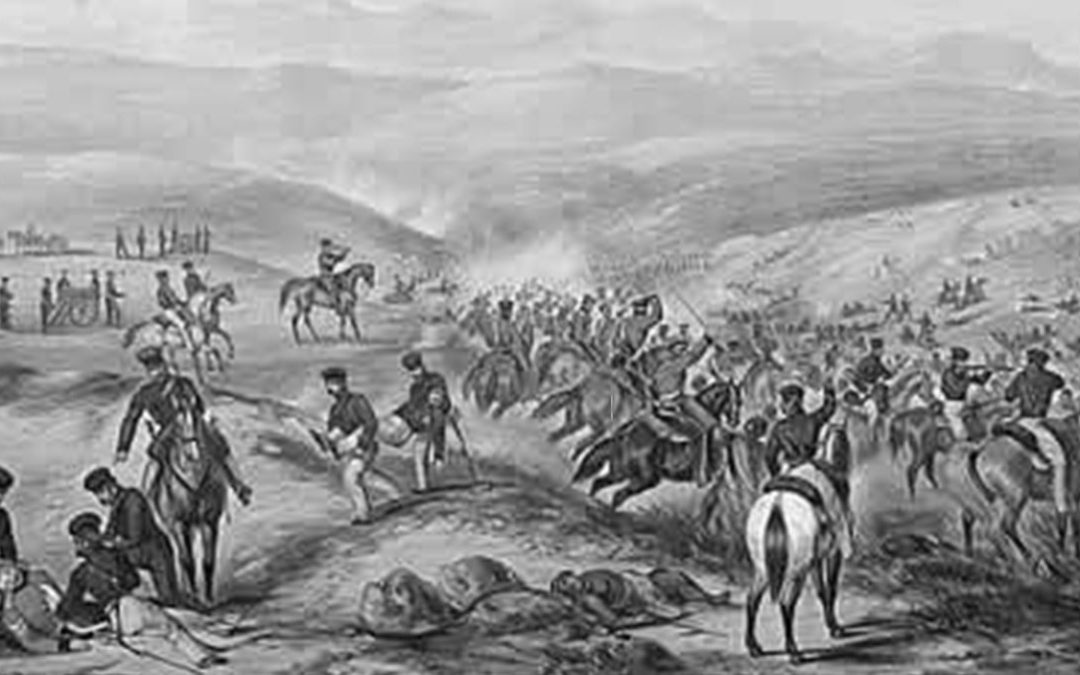
By 8:30 the first phase of the battle was concluded. Out in the Kerreri hills the 21st lancers were still on standby looking for a job of work to do. Orders soon came from Colonel Broadwood that they were to head off the retreating main force of the Dervishes and prevent them from re-entering Omdurman and impairing the capture of the citadel. They could see to the south a group of about 700, drawn up and facing towards the British horsemen. Little did the lancers know that they were about to be taken in by one of the oldest tricks in the Arab repertoire – because behind this apparently small force a further 2 000 were concealed in a dry watercourse. The order “Right wheel, into line, gallop and charge” was given, and the 400 lancers rapidly accelerated across the 400 yard intervening ground. With less than a hundred yards to go, the trap was sprung. From apparently out of the ground, a sea of men rose before them, twelve deep and spread across the entire front of the charge. Even if they had wanted to, the lancers could not have checked their charge. The irresistible momentum and speed simply carried them through, literally over the sea of bodies beneath them. Dervish casualties were high, but the lancers paid dearly – 21 dead, 65 wounded and a quarter of the horses killed. Churchill, in typically jingoistic vein, wrote to his mother : :We should have charged back at once – another 50 0r 60 casualties would have been nothing compared with the glory which we would have gained”. (It is interesting that this was the first and only time that the 21st had been in battle. It was the last great cavalry charge in history.
Shortly after the lancers had left on their ill fated mission, the army left the confines of the zariba on what was to be its final march. Thetwo British brigades advanced towards the ridge which ran between the Jebel Surgham and the river at the southern end of the zariba. At this stage of the battle there was a great deal of confusion and rivalry between the various brigades, and certainly very little intelligence regarding the whereabouts and remaining strength of the Khalifa’s army. Kitchener and his staff officers, advancing behind Colonel Maxwell’s brigade, appeared not to be fully aware of the developing situation with regard to what transpired to be a Dervish force behind the Jebel Surgham , fully equal in size to that which had been dealt with in the first three hours of the battle. When confronted with requests for orders to deal with the still-hidden threat behind the hill, he somewhat vaguely told the messengers to continue the advance on Omdurman – only to suddenly do an about face , and to instruct Colonels Lyttleton, Lewis and Maxwell to change direction to head off the Khalifa’s northerly advance to reinforce the heavy attack on Col Hector Macdonald’s brigade of Sudanese and the Camel corps. This critical development can be seen if we look at the situations at 9:40 and 10:15. This was a major turning point in the battle, and in a matter of minutes Yakub and the Khalifa’s threat was neutralised – causing them to head westward out into the open desert and away from Omdurman.
The Seaforth Highlanders were the first regiment to resume the final march on Omdurman, and their route took tham directly past the spot where the Khalifa’s great banner was still planted in the sand. As Kitchener and his staff came up in the wake of the Seaforths, the Sirdar ordered the banner to be taken up and carried in triumph before him. It was a vainglorious act which he was to regret before the day was out.
And so started the race to be the first unit to enter the town, with regiments jostling each
other and the situation almost getting out of hand. The glory of leading the final lap was given to the Sudanese, no doubt in recognition of the massacres that had been perpetrated against them under the Mahdi. The band of the Grenadier Guards struck up their regimental march, and the whole affair became somewhat bizarre in view of the fact that there were still some of the Khalifa’s men in the town, and Kitchener presented a very empting target in his white uniform. Quite unexpectedly a group of white bearded old men appeared and approached Kitchener – turning out to be the senior Emir of the town, come to surrender.
Inevitably the triumphal entry into the fabled city was an anti-climax. Here were no great palaces or mysterious temples of legend – just a rather sad and ruined heap of rubble, dominated by what was left of the Mahdi’s tomb. As the occupying forces approached the inner citadel no one knew what kind of reception to expect. From the odd burst of sporadic small arms fire it was clear that the area of the Treasury, the tomb and the Khalifa’s palace was still occupied – but by what sort of numbers was not known.
Unbeknown to the allies, the Khalifa and his small force of body guards had left the field of battle some four hours earlier and had entered the town ahead of the invaders. He had gone directly to the Mahdi’s tomb to pray, and had then despatched his wives and family away to the south in preparation for the last-ditch stand he anticipated against his enemies. Most of his followers had deserted him, and the remaining few openly jeered him as they hastily departed.
Although initially determined to obey the Arab code of honour which dictated that he should die, at the last minute his courage left him, and, after disguising himself, he fled in the direction of his fleeing armies.
As the allies entered the palace courtyard they were confronted by a considerable group of armed men amid the ruins. Some shots were exchanged, but eventually common sense prevailed, and the Khalfa’s men surrenderd – to be almost immediately conscripted into the Sudanese infantry.
Now followed a bizarre incident, which soured the victory and cost a considerable number of lives. As Kitchener and his group rode into the palace courtyard – he still carrying the Khalifa’s enormous banner on its long pole, it was spotted by the 32nd battery of field artillery. They had been posted outside the walls with strict instructions to open fire if they caught any glimpse of the Khalifa.
Several shells exploded in the courtyard before a bugler was hastily ordered to sound the ceasefire.
What followed is still today regarded by many as a barbaric act in a long drawn out campaign of revenge. The shattered Mahdi’s tomb was entered and his embalmed remains were removed and thrown into the Nile – except for his skull, which after a great deal of debate as to what to do with it, was finally buried in the cemetery at Wadi Halfa. It is on record that Queen Victoria was “Not Amused” when she learned of the desecration of the Mahdi’s remains and issued a severe reprimand of Kitchener.
The final act in this bizarre drama was played out on Sunday 3rd September 1898 in front of what little was left of General Charles Gordon’s palace. An interdenominational memorial service was held amid the rubble, with all the pomp and ceremony which the Victorians did so well. What a strange spectacle it must have presented. Under the flags flying from the shattered ramparts a strange miscellany of nationalities and uniforms – wailing bagpipe dirges and a twenty one gun salute from the gunboats, using live ammunition – the shells screaming over the heads of the assembled company, to land where ?
Omdurman today is not a place of pilgrimage. Who would the pilgrims be ? No one cherishes the memory of defeat, and the descendants of the so-called victors have little to celebrate with hindsight.
“Time hath an art to make dust of all things, as much of a man’s reputation as of his body – of the things that he did, and of the reasons for which he did them”.
Who knows or cares today why some 80,000 men fought to the death for this stretch of desert sand, all those years ago?