The ancestor of the family was the noble Graaf Jacob Van Reenen of Memel in what was then Prussia, who came to the Cape in 1721 in a sturdy little ship, the Astria. His brother Daniel was the Mayor of Allenburg in Prussia and it is said that he had to flee from his country because he took part in a duel, which in those days was strongly forbidden in Germany. And to crown everything, he had unfortunately killed his opponent. The archives show an investigation by the Prussian Government confirming proof of ownership of a large tract of land by the Van Reenen Family in Prussia, but the descendants of Jacob Van Reenen in South Africa never tried to claim those rights.
My great grandfather, Pieter Joseph Vink van Reenen, was born in 1877. He was therefore old enough to become involved in the Anglo-Boer War of 1899/1902. The family was not anti-British in their sentiments and up-bringing, and, in fact, English was their home language. In addition, he had so many friends and relatives involved on both sides of the conflict.
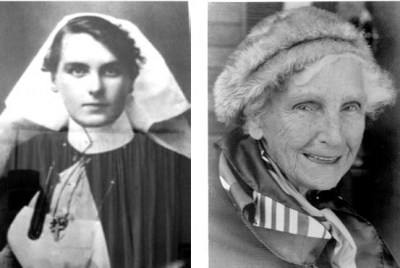
Before she had met my great-grandfather, on the other hand, my great-grandmother became involved in the war as a nurse on the British side. She had been born Florence Eleanor Cross an in Dunedin, New Zealand in 1878. Born of a Scottish father and a mother called Elizabeth of Irish descent, she was known to all as “Tottie”.
My great-grandmother’s father, Edmund Willoughby Cross, was born in Scotland in 1845 and emigrated to New Zealand as a young man.
A mining engineer by profession, he had been subpoenaed to give evidence in a court case in the Transvaal, involving the cyanide process of extracting gold from the gold-bearing quartz which had then recently been discovered in considerable quantities on the Witwatersrand. This visit resulted in him returning to New Zealand, collecting his family, and settling them in Cape Town, before returning to his mining adventures.
Having already been trained as a nurse in New Zealand, my great-grandmother served the British forces in the Anglo-Boer War while based in Cape Town. She served in various institutions, such as the Simons Town Military and Naval Hospital, and the Victoria Cottage Hospital in Wynberg, Cape.
It was while she was there that she became friendly with many of the Cape families. Cape Town was a much smaller place in those days, and getting to know people then was much easier than now. She became very friendly, through her nursing, with a Dr Claude Wright and his family and also the Bisset family, both well known in the social world of the Cape. It was through such friends that she eventually met the Van Reenen family, and eventually married my great-grandfather in 1904.
Farming at Redlands
Although my great-grandfather served in various departments of the old Cape Civil Service and did quite well, he yearned to go farming. Finance was, of course, the problem and the country was going through a difficult time as a result of the ravages of the Anglo-Boer War, but the opportunity came about at the time of the Union in May 1910. Prior to the Union, each province had its own network of civil servants and the four provinces had acted quite separately. When Union became an accomplished fact, the civil services were merged into a single unit and my great-grandfather was able to acquire a pension at the early age of 34. A joint pension scheme, it amounted to £9.19.7 per month, and continued to pay my great-grandmother until her death in 1976. Thus the pension went on for 66 years.
My great grandfather decided to join forces with his first cousin, Pieter J. Dormell, who was then still an official in the Forestry Department. Dormell would not take an active part in the farming venture other than to be responsible for his share of the capital to get the scheme going and the partnership was to last for ten years.
The question was where to farm? The Western Cape was more established and more expensive. They even thought of farming in Kenya for reasons which are still unclear as neither of them had ever been there. Dormell had spent his honeymoon in Knysna and the area appealed to him. The property decided upon was originally known as a portion of “Roodekraal”, but either the Hon. Barrington or Mrs Maurice had renamed it “Redlands”, of which the village of Barrington then formed a part.
The move took place in 1912 via train from Cape Town via George and included some livestock: a pedigreed bull, some brood mares, and an expensive pedigreed donkey called “Jack”.
From George they came with a regular horse-drawn post cart along the Seven Passes
Road which is now a National Monument designed to preserve the several historic old bridges which date back to the Victorian Era. The post cart comprised a coach and four to six horses, while the coach man had a bugle which he blew near the corner in the passes to warn any slow-moving ox-wagons to make way for His Majesty’s Royal Mail.
All sorts of farming were tried at Redlands without much success – from wheat, orchards, sheep, pigs and livestock. My great grandfather was a conscientious farmer and he raised some very good crops, but marketing was difficult. There were no marketing control boards so that prices were subject to violent fluctuations, and often the crops could not be sold in the limited markets that were available in the area.
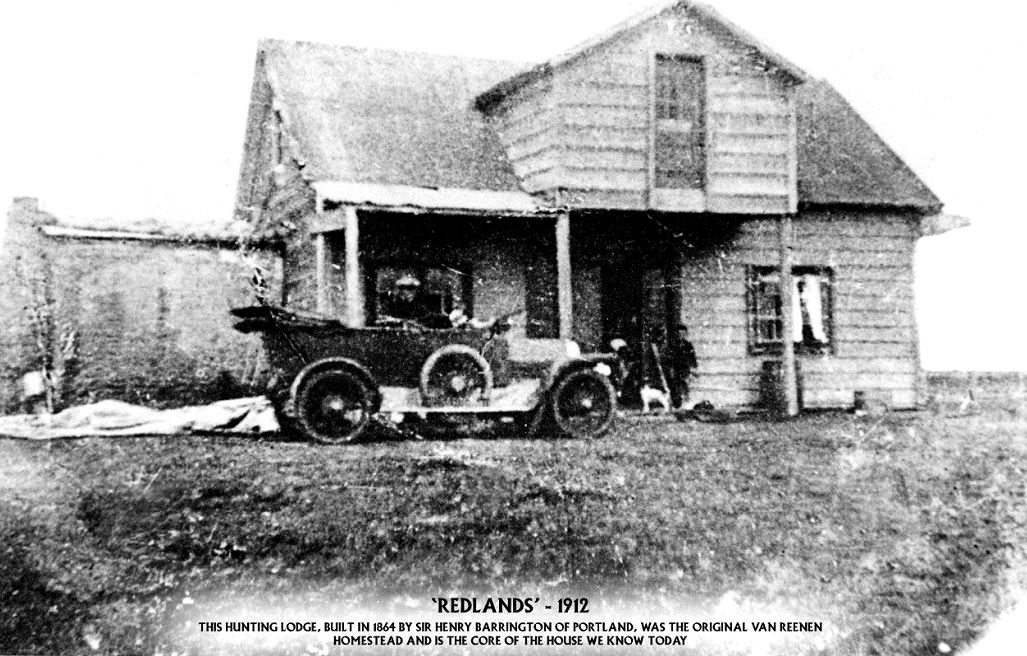
The Redlands house had been built originally for the Hon. Henry Barrington by a Norwegian named Franzen. The design had followed that of traditional Norwegian wooden houses, but the house was little more than a shack and was built to serve as a shooting box. When the Van Reenens first came to Redlands, the Hon. Barrington had been dead for some time and the house had squatters living in it, so it was run down and was in a poor state of repair. The house had a pigsty attached to the then back door. Tottie refused to stay there until it had been removed and made “live-able”. The furniture was very basic: consisting of a single wicker chair and paraffin packing cases for cupboards. Bathing facilities as we know them were non-existent and they had to make use of tin baths.
A Mrs Gabriella Stuart, a daughter of the Hon. Barrington, was a widow who was asked to go and live at Redlands and be the governess to the three Van Reenen children. Although she agreed, it soon became apparent that she knew nothing about teaching. My great-uncle Vincent remembers Mrs Stuart telling them that she dreaded being buried alive and had given special instructions to her doctor to make doubly sure by rather grisly means that she was indeed quiet dead.
Rheenendal
It was in 1920 that the Van Reenen Family purchased the “Rheenendal” farm. Registration of the farm was due to be made at the Deeds Office in Cape Town, as it was necessary for the farm to have its own name. For some obscure reason the solicitors must have decided on their
own initiative to name the farm “Fescue Meadows” – “fescue” being the name of a particular species of fodder. Why they should have chosen this name is unknown. There certainly was no fescue grass on the property. Our family remembers the story that a telegram had brought the news that the property was about to be registered and that the name “Fescue Meadows” had been suggested. Since the family back then did not approve of this inappropriate name, it was Tottie who suggested that the farm be named “Rheenendal”, in recognition of both the family name, and the ancestral home of Rheenen in Holland.
When Mr P.J. Van Reenen, Snr. was able to take occupation , he started farming operations there and commuted between “Redlands” and “Rheenendal”, sometimes on horseback, other times by bicycle, but mostly on foot. He claimed that this slower mode of transport, as compared with using a Cape cart, enabled him to think and try to sort out the many problems that confronted him at that time. The story is told that once, when using the bicycle, he was so deep in thought that when he got to the Klein Homtini he dismounted and went towards the water, thinking for a moment that he was on horseback, to give his “horse” a drink.
The Sawmill Industry in Rheenendal
Boekenhout, or Cape Beech, was estimated to have a value of 100,000 pounds on the property: attractive timber from a grain point-of-view but at that time there had been no demand as it was so soft. In order to generate cash from the forest, therefore, my great-grandfather employed some woodcutters on a share basis. The timber produced mainly spokes, felloes and ironwood wagon parts which were then sold to timber merchants in Knysna. These wagon parts were taken down from Rheenendal to Knysna town with the P.J. Van Reenen French Dewald Lorry purchased in 1928. The lorry was powered and driven by producer gas. It had a hopper attached on the driver’s side and into this wood chips would be fed. The initial start-up was on petrol and as soon as the producer unit was burning well, and gas was being produced the engine would be coaxed over to the gas, and the petrol switched off. It became quite a feature driving through the streets of Knysna. The Lorry had solid rubber wheels so that the ride on the corrugated, potholed roads, was by no means comfortable but at least there were no stops for punctures. At that time the main buyers were Thesen & Parkes who virtually had the monopoly and could regulate prices accordingly. So it was decided to start processing timber for themselves and hence the start of the Sawmilling industry in Rheenendal. The Sawmill started in August 1921.
The General Dealer & Butcher Shop
Since its inception in the early 1920s, “The Shop”, as it is generally referred to, had played an important, albeit unobtrusive, part in the development of our business, and as such justifies a short description of its progress and development.
Initially, when my great-grandmother first took over the shop, it was situated in what previously had been a storeroom behind the Rheenendal farm house. Some intervening walls in the storeroom were knocked out, shelves were put in, and a counter erected, and that then comprised the shop.
Later, a little section was cordoned off to become the so-called butchery. My great-grandmother was still doing the clerical work of the business and the shop was only opened when the odd customer came along. The mill and farm workers were given advances in the way of food, so the weekends in the shop were usually quite busy and there were no set hours. The woodcutters in Millwood were also “on the book” for basic needs, such as flower, sugar, and coffee. They were only paid at the end of the month and at 5 p.m. on the last day of the month, they would venture down to Rheenendal to pay their accounts and start afresh.
In later years, “The Shop” was moved to its present position, where eventually it became the base of the P.J. Van Reenen offices, General Dealer, Stinkwood Furniture Showroom, and eventually a Petrol Station, an ideal location, since it was on the Seven Passes Road. We were further granted a Postal Agency, for which the Government paid us £3 a month.
“The Shop” meanwhile went on and business gradually increased. The next step in the march of progress was the purchase of our first typewriter. Vintcent van Rooyen remarks that it is “Hardly a matter to record these days, but then it seemed to us that any concern that might own a typewriter was really going places. I remember it was a second-hand Remington, which we bought through an advertisement for a couple of pounds. It served us many years, but initially the problem was that nobody knew how to operate the thing. So, it having devolved upon me to fathom the intricacies, in due course I became quite a proficient two-finger typist, a skill in which I have never developed further, even though I have had to do all the typing for a number of years.”
Garth then went on to describe the latest exciting developments at the restaurant of “Totties” on the Rheenendal road, as well as all the developments in the surrounding area, including the rebirth of the Gold Mining Village as a tourist destination.
The first recorded history of boxing was found in Mesopotamia in the Tigris Euphrates Valley. A terracotta relief of 2 bare fisted boxers was found in the Ninto temple dated about 3000 BCE. This was in what is now Iraq. Other boxing reliefs were also found there.
Egypt
A relief showing boxers was found in Thebes dated around 1350 BCE.
Greece
Much more pictorial and writing evidence was found in Greece. A fresco from Santorini dated 1600 BCE shows a boxer wearing a single glove but much of the boxing in ancient Greece appears to be bare-fisted. The Greeks introduced the first hand protection in boxing. This was in the form of a leather strip which was about 4 meters long, made of soft leather and was wound around the boxer’s hands and wrists. They were called thongs or “Himanates”. They were first used in the Minoan civilization on the island of Crete about 1500-900 BCE.
“Sharp Thongs” were first brought into boxing about the 3rd century BCE. They were in effect primitive “knuckle Dusters” and were called Myrmikes or ants. They were lacerative weapons to add to the brutality of boxing but were banned in the 4th century as being too dangerous.
The ancient Greeks held boxing as a game played by the gods on Mount Olympus and therefore of great importance. Boxing was allowed in the 23rd Olympiad in 688 BCE. There is evidence in the Greek literature of disfigurement and even death resulting from boxing.
There were no weight divisions nor were their rounds. Scratching, biting and clinching were not allowed. In some forms of boxing wrestling was allowed. They were allowed to punch when the opponent was down. They often fought in a softened dirt pit called a skamma. The referee carried a forked stick to beat the boxer if he broke the rules. The fight was terminated when the boxer could not continue or there was a one-finger surrender.
Boxing in ancient Greece was certainly not gentlemanly. They fought for glory and immortality. They were not thugs but highly trained, well-conditioned, and extremely skilful athletes.
Rome
Boxing was also very popular in ancient Rome. Here, however, it became a gladiator sport, where the idea was to fight to the death. To assist in this, they introduced the caestus. This was a boxing glove with hardened leather over the knuckles. It often had spikes to do more damage.
England
Very little is known about boxing in the Middle Ages, but the first documented boxing match in England took place in 1881 when the Duke of Albermarle organised a fight between his butler and his butcher. In the early days there were no rules, no gloves, no weight divisions, and only one champion. Wrestling was allowed and you could hit a man when he was down. This was similar to what is known as “cage fighting” today.
Broughton’s Rules
Jack Broughton became the father of modern boxing when he introduced the first set of rules in 1743. This was after he killed an opponent in 1741 and he introduced “mufflers”, which were the precursors of the modern boxing glove.
A round continued until a man went down. You were not allowed to hit an opponent when he was down and after 30 seconds he had to be one yard from his opponent in the centre of the ring or the opponent would be declared the winner.
These rules held until 1838.
London Prize Ring Rules
These were more detailed than Broughton’s rules. Kicking, biting and low blows were all declared fouls. Known as “the mark”a line was scratched in the centre of the ring and – after a knockdown – the boxer had 30 seconds to get to themark.
The ring was actually 24-ft square and had two ropes supported bystakes.The prize money was often put on one of these. From these rules arose many modern English idioms, such as –
“to come up to scratch” – to meet the qualification
“to start from scratch” – to begin again
“not up to the mark” – not up to the necessary level
“a draw” – stakes were drawn out of the ground to drop the ropes to stop a fight when there was no decisive winner
“stakes” – the money for the fight which was put on one of the stakes
“against the ropes” – battling against adversity
“knockout blow” – a telling point in an argument
“a knockout” – a beautiful girl who has you down on your knees
The Marquis of Queensbury Rules
John Graham Chambers of the Amateur Athletic Club devised a new set of rules in1867. Having enjoyed the patronage of the Marquis of Queensbury, the following rules were observed:
differing weight divisions
padded gloves
three-minute rounds with one minute rest in between.
wrestling was declared illegal
a fighter who was knocked down had to get up unaided or be declared knocked out.
Bare-fist Boxing
Boxing gloves were initially scorned by boxers as being unmanly. Many people still believe that bare-fist boxing is safer than with boxing gloves. This is because bare fists are so hard they are less likely to b used against the head of the opponent. Boxers today also have methods of strengthening their hands so that they can hit the opponent’s head without fear of damage. There are no accurate statistics to assess death or severe injury in the ring in the bare-fist days.
The last bare-fist boxing match took place in the USA in 1889 between John L Sullivan and Jake Kilrain. Sullivan, who became the heavyweight champion, was the first American to do so in 1882. In 1889 when he fought James J. Corbett it was under the Marquis of Queensbury rules.
Bare-fist boxing initially took place only in Great Britain, but later became popular in the USA, owing to immigration. Its popularity in Great Britain had its ups and downs which were dependent on religious views and the influence of the aristocracy. On a number of occasions they tried to ban boxing but failed.
Boxing among African-Americans
Initially,it was extremely difficult for black boxers in the USA because white boxers, such as John L Sullivan and Jack Dempsey, simply refused to fight them. Jack Johnson was the first black heavyweight champion in 1908, but a great change took place when the black US champion Joe Louis fought the German Max Schmelling in 1936 and 1938.
Boxing Gloves
The first gloves for boxing contained horse hair and were covered by leather and the thumb was only attached at its base. The problem with using horse hair or similar fibre alone is that the fibre can compress and disperse from the impact area of the knuckles. This means that in a boxing match the cushioning in the glove may be adequate in the beginning but will rapidly deteriorate as the fight continues. So in the last 30 years changes in the cushioning of the boxing glove have been made largely to make boxing safer. Closed-cell foams are now used to prevent the deterioration during a fight. Most boxing gloves today have the thumb portion of the glove fully attached to the rest of the glove to prevent eye gouging.
Deaths in Boxing
The main reason that the changes in the cushioning have taken place is to prevent death or serious brain damage in the ring. It has been scientifically shown that brain damage is caused by rotation acceleration to the brain as a result of the force of the punch. By reducing the force of the punch with better cushioning in the glove the chance of brain damage and death will be reduced.
Recent Changes in the Rules
To reduce the possibility of severe brain damage changes in the rules have taken place. Championship fights have been reduced from 15 to 12 rounds and m medical supervision has been given far greater importance so that the fight can be stopped sooner than later. Better medical facilities have also been enforced so that, if treatment is needed, this can be introduced immediately.
The Griqua Story starts well before any influence of Western Civilisation ever reached the shores of the Cape of Good Hope. To understand the Griqua Story it is necessary to understand the Heritage of those people who called themselves “Khoikhoin” (“Men among Men”), or “Khoin” for short.
One has to remember that the Khoin from Central Africa were nomads who travelled south with their livestock wherever they went. They later came into contact with the original southern African hunter-gathering people, commonly known today as the Bushmen.
The lifestyle of the “Hottentot” branch of the Khoi people was one of a community-based, pastoral type of nomadic culture. This culture included a lot of story-telling about life within and among these nomadic family groups. The Hottentots’ way of life may be viewed today as idyllic and something of which modern urbanised culture can only dream about. Put in another way, the Hottentots were a very contented and happy people who lived on meat, milk and edible plants in large family-group, community arrangements with only the basics of shelter, and lots of time to roam around and tell stories. Although a ruling chief might be appointed, the position was no more than that of a “spokesman”. In Hottentot culture, no man or women was seen as being “above” the others and all major decisions were taken by the community at large.
This description would have been typical of the culture when Jan van Riebeeck and his men arrived at the Cape. In complete contrast to this Hottentot culture, the men of the Dutch East India Company arrived with the purpose of protecting the flow of profit from Dutch Batavia in South Asia and the spice-rich Far East. This protection required that the landfall immediately adjacent to Table Bay be secured as a refreshment station and a safe haven in order to look after the needs of passing ships.
One cannot imagine, therefore, a more misunderstood clash of cultures between the Hottentots’ way of life and Van Riebeeck’s “profit-based” culture. The Hottentots did not stand a chance of survival against this “need for profit” way of life and for the price of a few shiny glass beads and copper plates and absolutely no comprehension of the meaning of permanent land ownership, the Hottentots gladly welcomed the Dutch visitors, thinking that – like so many seaborne visitors before – they would soon move on. How devastatingly mistaken the Hottentots were!
Within a year of Van Riebeeck’s arrival, the first offspring between the Dutchmen and the local Hottentot women were born – and who could blame the 82 men who arrived with Van Riebeeck without female companionship? And so the needs of these men were thus satisfied by the Hottentot women in exchange for glass beads, copper plates, tobacco, and especially brandy.
With little else to trade other than their bodies the Hottentot women quickly gave in to these addictive pastimes supplied by the Dutchmen and within months the entire social structure of the Hottentot families imploded completely. The Hottentot men equally took on too many of the white man’s ways by drinking to excess and signed away their land rights for as little as a bottle of brandy.
It soon came to pass that the new settlers viewed the local Hottentots as being indolent, lazy and having an inferior culture and intellect. It is from this attitude that the Khoin were branded generally by the settlers as “Hottentots” after the stuttering and broken way the settlers heard the language spoken.
It is also against this background that the co-existence of an exploding, “illegitimate Coloured” community gave rise to the Griqua people: a true South African “Rainbow Nation” of mixed bloods including Hottentots, Bushmen, Chinese, Dutch, British, Indians, Malay, Korana, Xhosa, and the descendants of freed slaves from elsewhere in Africa.
In Scott Balson’s book, Children of the Mist a fairly accurate story is told of the life and times of the Griqua people. In the book, Francine is born out of a union between her mother, an indentured slave girl, and the farmer of a settler family. Francine is also a slave and at the age of 14 she is raped by one of the farmer’s sons. After a few months Francine was no longer able to hide the child growing within and just before the birth of her son she is thrown off the farmer’s lands after the dark secret comes out.
Francine walks for miles in the direction of Stellenbosch and collapses exhausted on the side of a road. A farmer by the name of Adam Tas sees Francine, and takes her to his farm where she later gives birth to her son and names him “Adam” after the farmer who helped her.
About 20 years later, Adam Tas was taken into custody for his opposition to the reign of Cape Governor Willem Adriaan van der Stel and his two sons take over his farm. Shortly afterwards, one of the son’s wives catches her husband and Francine in adultery and the son is forced to throw Francine and her children off the farm. Sadly, Francine’s experiences were shared by thousands of Hottentot women in similar circumstances across the emerging Cape Colony, where the mixed-blood population, later to be called “Coloured” grows exponentially.
Francine and her family make their way to Piquetberg, some 100 kilometres north of modern Cape Town, in order to escape from the influence of the settlers. Here they live by their wits, raiding gardens for food and stealing livestock. It was into this deeply rejected community that Francine’s grandchild, Adam Eta, born in 1710, a mere 58 years after Van Riebeeck’s arrival.
Three years later, an epidemic of smallpox breaks out and many tens of thousands of Hottentots and others are killed by the disease, leaving only a few pockets of Hottentots to pick up the pieces. Smallpox effectively did what no gun had been able to do – the removal of the local population as a problem for the colony.
With still a sizeable number of people of mixed descent in the Cape and very few original Khoikhoin left, those who were later classified in the late Nineteenth Century as “Coloured” people were now totally cut off from their Hottentot roots and saw themselves more as “Europeans” and so attempted to imitate the settlers’ culture, religion, and lifestyle.
Adam Eta’s parents had both died from the smallpox epidemic and so he ended up being brought up by slaves belonging to a farmer in the Piquetberg area. He was soon noticed as a capable slave and was soon being trained as the farmer’s cook.
At the age of 25 Adam Eta joined the farmer on a journey to Cape Town as his cook and while in Cape Town the Governor of the Cape noticed Adams cooking ability. He was quickly exchanged for an additional parcel of land by the farmer and became Head Chef to the Governor of the Cape at the Castle, the official residence in Cape Town. Here he was given the name “Kok”, meaning “chef” in English.
It was during Adam Kok’s time at the Castle in Cape Town that he realised the extent of the deprivation of the Hottentots since the land that once belonged to his forefathers had been taken and given to the incoming settlers. He saw first-hand how the white man’s influence had crippled and extinguished any connection to his Hottentots roots, so often spoken about while he was growing up in Piquetberg.
Five years later, around 1740, there was a change of Governors that won Adam his freedom. With his large payout of several hundred Rix Dollars he purchased an ox wagon with all the trimmings and on returning to the farm he was brought up on he found it burnt to the ground. He met one of the slaves that had once worked at the farm and was told of the hostilities between his people and the settlers.
They had found an ideal spot on the slopes of the Voorberge to hide out in and for the next couple of years a number of outcasts, both of mixed heritage and white men, took refuge here from the Governor of the Cape while the practice of raiding and looting settlers farms continued as the only means of survival.
As the Dutch settler population expanded and occupied the land in ever-growing circles from Cape Town, however, Adam realised that their once isolated sanctuary on the slopes of the Voorberge was under threat of discovery. By this time, the previous leader, Koos Kleinman, had died and Adam had been selected to lead the community. In the spring of 1743, therefore, Adam packed up the settlement on about ten ox wagons and headed away to the north to become the first Voortrekkers in history.
What is very interesting here is that it was for exactly the same reasons that the Voortrekkers ventured north about a century later: to escape the influence of the Governor of the Cape but more about that a bit later.
From this time on until the establishment of Philippolis by the Griquas in the southern Free State in 1823, this period can best be described as the founding years of the Griqua people. These were the years that saw their settlement of in the Northern Cape and later the southern Free State. The highlights of these years include:
The merging of the starving Chariguriqua clan of the original Khoi people and Adam Kok’s clan as they travelled north, including the union of Donna, the Chariguriqua chief’s daughter, and Adam Kok.
The raiding of sheep and cattle from Adam Kok’s people by the Venters, the first of the Trekboers, or frontier farmers, who were encouraged by to settle in the Cape interior.
The creation of the Griqua Bergenaars, a group of marauding scouts of the Griqua who effectively annihilated the Bushmen wherever they went.
The move of Kok’s people across the Orange River into the Langeberg after huge herds of game had stampeded through the Griqua’s camp totally demolishing everything in their path to get to the other side of the river.
Within 50 years of the arrival of these frontiersmen these massive herds of game
had been decimated to such an extent that they disappeared from the area.
The arrival of vagabonds such as Stephanus who held himself out to be a prophet and who was a great story teller, you might say the story teller of story tellers. And Jager Afrikaner, a vicious marauding bandit on the Cape’ frontier. Both men were renegades on the run from the long arm of the Governor of the Cape.
The arrival of Barend Barends together with 30 men women and children and several hundred head of cattle from the Cape. He was being harassed by the notorious Jager Afrikaner who often took delight in firing gunshots into the ground which scattered Barends livestock making them easy pickings for Jager and his men.
The establishment of Hardcastle in the Northern Cape and the official appointment of Adam Kok as “Kaptein” of the area, meaning Leader or Chief in Charge. This was declared by the outgoing Dutch Governor who was to be shortly replaced by the British Governor when the British took over the Colony for the first time in 1795.
By this time, Adam Kok I was 85 years old and an aged leader of a people who looked forward to a bright future. Adam handed over his Captaincy to his son Cornelius Kok. With so many new arrivals from Hardcastle, Cornelius decided to move his outgrown camp to what is today Griquatown in the Northern Cape. This town was initially known as Klaarwater.
Into this mix came the first missionaries, Anderson and Kramer, who managed to tame some of the wild ways of these frontiersmen and women. Then came another missionary called Campbell who took offence to the name given to these people initially called “Basters”, a term derived from the Dutch, meaning “illegitimate”. He came up with the name “Griqua” from the association of Adam Kok I with the Chariguriqua people, a name which was an instant hit with Adam’s followers, and so the town was renamed “Griquatown”.
The influence of these missionaries on the Griqua was in some ways cruel, as they imposed an imported Western ideology on top of a culture relatively unchallenged in its way of life, free of the Trekboers, free of the influence of the Cape Colony, free to hunt, laze around, tell stories and watch over their herds of cattle sheep and goats.
The imposition of these Western laws and regulations and their associated harsh penalties on the Griquas by the missionaries caused intense internal conflicts among the leading Griqua families and a movement away from these established leaders to set up separate Griqua settlements.
Also, let us not forget the Korana people, the original Khoi clan, that had long before settled just north of these new Griqua settlements as well as the groups of Griqua Bergenaars who were constantly on the move, and which now included every creed living in the area.
During the first quarter of the 1800s, some large changes occurred in the lives of the Griqua people. One of these was the establishment of a Bushmen mission station at Philippolis in the southern Free State by Dr John Philip from the London Missionary Society, who had accompanied the missionary Campbell during his first missionary visit to the area.
Dr Philip was later appointed as Super-intendant of the London Missionary Society and while on a previous visit to the Griqua area, Adam Kok, the son of the now Kaptein, Cornelius Kok, had spun Dr Philip a wonderful tale of how he and some fellow Griquas had come to the assistance of some Bushmen who had been cornered by a pride of lions.
The influence of this humanitarian theme was cause for Dr Philip to award Cornelius Kok’s Griquas the area north of the Orange River, today known as the Free State, in exchange for the assurance that the Bushmen in the area would now be protected. The good Doctor had no idea he had been hood-winked and the fate of the Bushmen was now certainly sealed.
It must be pointed out that, had the Griquas not exterminated the Bushmen, the Boers would most certainly have done so for it was the method of their execution that was learnt from the Boers that was applied by the Griquas whenever they came across these unfortunate Bushmen families. The male Bushmen was shot in the legs effectively immobilising him and thus being unable to hunt for food resulting in the excruciating death not only of the male Bushmen but his entire family, who eventually died from starvation. One has to understand that life on the frontier was difficult and harsh, as was the method the Bushmen used on both Boer and Griqua in stealing their livestock – the Bushmen would shoot the herdsman with a poisoned arrow if need be, usually in the neck area, who also then died an excruciatingly painful death, whereupon the Bushmen would take off with some of the livestock.
Adam Kok II then took the opportunity given by Dr Philip to leave the strife torn areas around the now established Griqua settlements of the Northern Cape and establish his group at Philippolis in the southern Free State.
Around this time the Ndebele tribe, having moved away from the influence of Shaka’s Zulus in the East, was now plundering the Mantatisi’s tribe, the Griqua’s allies in the north, from whom game and elephant tusks had been traded which in turn had been traded by the Griquas to the Trekboers in the south for brandy, guns, and ammunition.
Reports came in from the Griqua Bergenaars that Mzilikazi, the Ndebele chief, and his men were away plundering tribes in the far north leaving their large herds of livestock unprotected, which appeared to the Bergenaars to represent easy pickings – or so they thought.
Word spread quickly through the Griqua settlements and within a day or so, 800 armed Bergenaars prepared themselves to steal and plunder the Ndebele’s large herds. It took several days just to round up the large number of animals that the Bergenaars wanted to take with them. Being far too many to successfully drive back to the Griqua lands, the raiders were nevertheless consumed by an overwhelming desire for this enormous wealth in livestock, so they miscalculated the enormity of the task and began determinedly to drive the cattle slowly back home.
Soon the Ndebele scouts were tracking the Bergenaars’ progress, while planning their attack on the slow-moving trail of dust. When it came, the Ndebele attack was quick and fatal. Now knowing by observation that there were no Bergenaars awake during the early hours, they struck at dawn. Several Ndebele men were able to surround each Bergenaar as they slept and on the given signal, all 800 Bergenaars were simultaneously slaughtered as they slept and the stolen livestock was taken back. Word quickly spread of the annihilation of the Bergenaars and what was left of the Griqua nation grieved at their loss, since every living Griqua at the time would have been related in some way or another to one or more of the men that were now dead.
Moreover, the Ndebele were now moving south and all the Griqua settlements were consequently also under threat of annihilation, having lost so many of their fighting men. This would have been the case had it not been for a fearless missionary from Kuruman by the name of Robert Moffett. Unarmed and alone, he entered the Ndebele stronghold and somehow (I would like to think by Divine intervention) negotiated with Mzilikazi to take the Ndebele tribe further north and to settle in the area known today as Matabeleland in Zimbabwe.
Adam Kok II and his people were relatively unaffected by the loss of the Bergenaars at Philippolis in the south and he took the ascendancy as Kaptein of the Griqua people. Word of the good grazing and plentiful supply of water spread, which encouraged many Griquas in the other settlements to make the Trek and re-settle in the lands around Philippolis.
It must be explained that at this time the political situation in South Africa was that the Cape Colony had been under British Control since 1795. The Cape Colony was given to the British as bounty for their part in the Napoleonic wars in Europe. The British had quickly imposed their style of colonial administration on the original Dutch settlers who promptly took exception to their Rule of Law, which included the abolition of slavery in 1834. This seriously affected the livelihood of many Dutch settlers in the Cape and consequently led to the mobilisation, known today as the “Great Trek”.
The Griquas had already established long-standing and mutually beneficial trading relations over several generations before the Great Trek. Both had experienced the harsh conditions of the interior of the Cape Colony.
The Voortrekkers, on the other hand, were more like established townsfolk. Numbering some 15,000 strong, they were well educated and very angry at having been displaced from the Colony. Having trekked to the north, they subsequently made their way through to the reqion of Philippolis on their way to settle in Natal.
As the Voortrekkers trekked north to Natal and, finding that Natal had been annexed by the British, remembered the good lands they had passed through that had belonged to the Griqua people, so the Voortrekkers headed back over the Drakensberg into the Orange Free State, where they outspanned on the plentiful sweet grass and good supply of water albeit on Griqua land.
By this time, Adam Kok II had passed on and the Kaptein position was taken up by his son, Adam Kok III. Several years later, after the Voortrekkers had come back from Natal, Adam Kok III realised later that the underlying need of the Voortrekkers was to achieve “selfstandigheid” or autonomy, which came at the expense of the Griqua people. Aided by the British authorities, the Boers had taken up 40-year leases with the Griquas in the Orange Free State. One of the conditions of these 40-year leases was that ownership would revert to the lessee (that is, the Boers) should the improvements made on the land not be re-imbursed. And of course, no individual Griqua would be able to do this, given the Griqus community based lifestyle.
This realisation came too late for Adam Kok III, who had entrusted the land allocations to Hendrik Hendriks, the Secretary of the Griqua Governing Council, or the “Raad”). After further negotiations, however, Adam Kok’s people were able to occupy Noman’s Land below the Southern Drakensberg, a region having been previously emptied of people at that time by Shaka’s Zulus, now known as Kokstad.
Later, a complete misunderstanding arose among the Griqua Council and its people, and the British were soon making accusations against them for maladministration of the area of what was then called East Griqualand and promptly annexed the area in 1874. To add to the woes of the Griqua people, Adam Kok III died in 1875 leaving a leadership vacuum that was never effectively filled.
It was during this time that the Griqua people, still with no understanding of land ownership, signed away their title deeds for brandy and credit at Strachan & Co, who also took Griqua title deeds in lieu of the many outstanding loans payable by the Griquas, who had no way of paying them back. It was not long before more white people came into the Kokstad region buying up valuable land for a fraction of the value being asked by their Griqua owners.
And so for a second time the Griqua people became displaced and despised by the whites and, with no real leadership, the community imploded once more before calling forth from among its ranks the Griqua profit, Andrew Andries Stockenstroom Le Fleur, who married Rachel Susanna Kok, daughter of one of the direct descendants of the Kok family. Le Fleur was thus chosen by the Griqua people to be their Paramount Chief. He began by stirring up the Griqua people against the British, who then regarded him as a rebel. Le Fleur was duly taken into custody and was sent to the Breakwater Prison in Cape Town in February 1898. He was later released along with Boer prisoners-of-war in 1903.
Le Fleur then successfully established a long- standing girls’ choir called “Die Roepers” (“The Callers”). Their mission was to travel around South Africa, singing and working for Griqua unity. Many of their descendants continue this tradition to this day.
Le Fleur also organised various treks in the 1900s, of which the 1917 trek from Kokstad to Touwsrivier, about 200 kilometres from Cape Town was the most disatrous, causing the people returning to Kokstad to be a lot poorer than when they first started out.
In 1928, however, Le Fleur set off again from Kokstad on a more successful trek to Kranshoek, just outside Plettenberg Bay. This more successful trek drew many Griquas from around the country as word spread of its progress. And so today we have the Griqua National Conference head-quartered right here in Kranshoek.
Despite Le Fleurs failings and controversies that seemed to follow him wherever he went, therefore, he nevertheless ended up as a successful leader and a continuing inspiration for the Griqua people. His vision from God inspired him and in turn his prophesies inspired the Griqua people and it is through him that the Griqua independent church flourishes today in all the active Griqua communities of Namaqualand, Campbell, Kimberley, Griqua-town, Kokstad, Philippolis, the Cape Peninsula, and, of course, here in kranshoek.
Le Fleur died in 1941 and is buried on the Robberg Peninsula, close to Kranshoek. His Grandson, Alan Le Fleur of Kranshoek is now the Paramount Griqua Chief, a direct descendant of Adam Eta Kok who started it all those years ago in the 1700s.
With the build-up of the first free and fair democratic elections in SA in 1994 the Griqua people amalgamated with the general Coloured population but today the culture and traditions of the Griqua people are remembered through their independant church, as well as the singing and dancing traditions celebrated throughout their calendar year.
Commissioned in 1788, Plett’s Timbershed is an important symbol of the economic development of our sub-continent as envisaged and thereafter made good in the late-18th Century. For it came to be built and commissioned here at Plettenberg Bay – on instructions of the Dutch East India Company through its representatives at the Cape – to address pressing economic needs, stemming largely from what was then the enormous significance of timber in the colonial economy and also worldwide.
Between the time of Jan van Riebeek’s arrival in 1652, and Governor van Plettenberg’s 1778 visit to what would, largely due to his initiative, be the Timbershed’s site, there had been, quite literally, a considerable change in the colonial landscape: from Cape Town all the way to the future George, much of the Colony’s timber had already been axed for a multitude of essential purposes including transportation (carts and wagons), buildings, bridges and harbour installations. Also for export, especially to other parts of the far-flung DEIC ’empire’.
Wagon-loads of hewn timber were at that time a common sight on the primitive coastal roads linking Cape Town to the colony’s eastern reaches.
However, comparatively little timber had up to then come from points east of George between the sea and the rugged mountain range. This had been largely because of transportation problems, not least the natural barrier presented by the approaches to Kaaimans River, as well as by the river crossing itself–for bridges of any significance were to come much later on.
Thus it was that Governor van Plettenberg when he paid his visit to this Bay in 1778 with Gordon, was favourably impressed by the local forests then scarcely axed and, at the same time, by the possibilities of using sea transport in the chain of exploiting this natural resource for a multitude of desirable purposes, domestic and export.
Fast-forwarding to the present day, the Timbershed is, therefore, worth preserving for all it represents in terms of past achievements in meeting the then colony’s steadily growing economic needs.
But how? And with primarily just what in mind?
Is the Timbershed regarded as a relic or a ruin? Should it be preserved or restored? The National Monuments Council declared it a national monument in 1937, describing it as a ruin. Heritage Western Cape, in line with worldwide thinking on these matters, now engages professionals to investigate, assess and decide.
The original structure had timber beams, most probably yellowwood, spanning over six metros and supporting a boarded flat roof covered with brak klei (taken from dry pans where nothing grows) and sealed with whale fat. Under the weight of rain water the roof would have sagged, preventing complete run-off. Sagging would have caused cracks for leaks to slowly rot the timber below until the beams collapsed. The Timbershed’s stone walls would have been rendered-and-lime-washed, with timber lintels over the ten window openings on the long walls. As the timber lintels decayed the stone-work above collapsed and many of the stones have disappeared.
Considering restoration: could the cost be justified of providing yellowwood beams (one could certainly not use tannalith-treated gumpoles) and stonework (to be hidden by rendering and limewash), if the structure was doomed to similar decay and collapse? Alternatively, should restoration follow the Mossel Bay example?
Not far from Plett, at Mossel Bay, there was an 18th Century South African relic, the Grain Store, of almost identical size and construction. [That has been rebuilt after a fashion in the 20th century–Recent photograph displayed.] “How many of you,” Len Raymond asked, “have seen and visited the shed while in Mossel Bay and looked inside?” …”It seems nobody at all!” (Stunned silence.)
The original Grain Store would, like the Timbershed, have had rendered and lime-washed stone walls. It would also have had timber beams spanning over six metres supporting a boarded flat roof covered with brak klei and sealed with whale fat. In preparation for the Dias Fifth Centenary in 1986, the existing modern factory on the site was gradually demolished in the hope of finding substantial evidence of the original shed. As it turned out, only stone foundation walls remained.
The decision was made to build a structure of the same dimensions and form, with ten windows on either side and a flat roof – only the walls would be plastered brick and gum-poles be used for the roof. It looks, certainly on the outside, very much like a 20th Century packing-shed and houses activities associated with tourism. Is this an example to be followed at Plett?
Further away from Plett, at Melkbosstrand, there is an older and smaller 18th Century shed. At a time when it was considered safer to come ashore at Melkbosstrand in preference to Table Bay, a stone-walled and thatch-roofed shed was erected to store arriving goods or goods readied for export. It has remained – as a store of sorts – in substantially the same form up until the present. Here you can see restoration work in progress. Stonework has been repaired as has the roof structure, which is now being thatched. [Photo available]
In Mandalay, Burma, there is another old building of the period, but one that looks as though it may have been rebuilt, repaired and/or preserved very much in its original style.
In Malaysia, Malacca as a whole was named a World Heritage site in 2007. What remains of an 18th Century building has been stabilized; the floor that has been laid includes Dutch gravestones; and it has been opened to tourists
In Norway what remains of Hamar Cathedral, an 18th Century building alongside Lake Mjosa, is today enclosed under a huge steep-pitched clear-glazed canopy supported by an open steel lattice framework. The ruin is thus protected from further decay by the elements or plundering, and is given significance as being worthy of preservation. The canopy creates a precinct that speaks volumes for local civic pride and, at the same time, for its pull as a tourist attraction.
Of the examples discussed, the glass canopy may have been much the most expensive, but the result may also be judged the most impressive; and surely also the best in terms of protecting old if not original structures, in safely housing other relics of an increasingly distant past; and – not least – in attracting local and visitors’ attention.
The Fagan proposal, which I have only recently seen and which – incidentally – has never been presented to HWC, leaves about a third of the Timbershed unroofed with two-thirds roofed in a manner similar to the original. It would be used as a restaurant and for small open-air production productions.
Plett might do well to consider the Timbershed as part of a historical precinct with the Timbershed opened to the sea, with the Diaz beacon on one side, and the to-be-restored Rectory on the other. As such it could provide a worthy tourist attraction. We have a duty to future generations to preserve things, so the cost should not be assessed in terms of financial viability but rather in terms of these enduring cultural values.
Some suggestions:
Get the VPHS registered with Heritage Western Cape as an ‘Interested and Affected Party. This is provided for in the legislation; and would ensure the opportunity to have a say – and before that, to have sight of all proposals for alterations and/or usage of the Timbershed requiring official approval.
Form, or participate in the formation of, a Trust to take over or have an ownership share in the Timbershed in place of present sole-ownership by the Municipality; or merely to achieve recognition as ‘an interested and affected party’.
Register the Trust with HWC as an ‘interested and affected party’ in respect of any applications or decision-making affecting the Timbershed that it may be considering from time to time.
Persuade Bitou Municipality to permit the Trust to deal directly with Heritage Western Cape.
The Tsitsikamma Rivers Project, launched in 2008, is a quest to understand and conserve the river systems of the Tsitsikamma mountains which are valuable natural assets of this area.
In many parts of our country the river systems are in a parlous state, to the extent that some are dubbed the ‘sewers of South Africa’. Some rivers are already dead, others are endangered. Even in our area, rivers are polluted. For example the children of the primary school in Kurland Village are involved in a clean-up project, organised by the Nature’s Valley Trust, in which they regularly relieve their river of tons of rubbish.
The Tsitsikamma Rivers project, a large research project, was – in a roundabout way – set in motion by a gentleman making application to establish a trout farm in the Salt River area, which in turn prompted Cape Nature to investigate the ecology of the river. The Trout Farm application was unsuccessful because of the findings of the research consultants who reported a remarkably rich diversity of aquatic insects in the river.
The project of today’s presentation was initiated and coordinated by Nature’s Valley Trust and funded by Table Mountain Fund which is linked to World Wildlife Fund. The research teams were drawn from the Department of Water Affairs, Albany Museum and the Universities of Rhodes and Stellenbosch. SANParks and Table Mountain Fund played a constructive supportive role in formulating and supporting the project.
The eleven rivers studied range from the Matjies in the west to the Groot Rivier which lies east of Storms River. These are short rivers, typically 15 km, rising in the Tsitsikamma Mountains. These fynbos covered sandstone mountains with their numerous gorges determine the nature of the rivers which are cold, fast-flowing, well oxygenated waters with little sediment. These rivers are acidic and of a red-brown colour, due to the presence of humic acid. Despite the colour, the water is potable, and probably of the finest quality in the country.
The first phase of this project was completed last year and involved the study of the aquatic insect population located in the 11 rivers running from West to, are: Matjies, Buffels, Salt, Groot (W), Bobbejaans, Bloukrans, Lottering, Elandsbos, Storms, Elands, Groot (E). Importantly the degree of presence and diversity of the insect species in their various habitats is a reliable indicator to the health of a river and therefore its conservation worthiness.
Future phases of the project will focus on how best to implement the stewardship of these beautiful waters.
It was found that the upper reaches of two of the rivers were completely inaccessible by humans on foot, affording perfect protection of the ecosystem. Helicopters were used to gain access to these rivers.
The research teams collected insects by a variety of sampling techniques which included special daytime flight traps, ultra violet light traps for night flying insects and hand nets for both larvae in the river and flying adults in the air. Samples of both larvae and flying insects were identified by scientists at Albany Museum and, in some instances referred to specialist organisations locally and overseas. It was found that, while some insects are common to all of the rivers, many are specific to their own river systems. It was also found that the upper reaches of the rivers were markedly different in species composition from the lower reaches and usually contained a greater diversity of species. Thirty-four species and four genera new to science were identified within known families.
The insects have many remarkable behavioural characteristics: the caddisfly larvae, for instance, protect themselves from predation within cases made with silken threads which bind together particles of sand, leaves and plant stems, each species having its own specialist design. As with hermit crabs in the sea, there is competition for good homes and one species will often take over suitable cases from another and certain of them add a distinctive canopy over its head. Once airborne, the caddisflies become superb flyers, sometimes tinted blue or green by the light and some with golden-coloured wings. Often an abundant egg mass hangs from the abdomen of an adult female caddisfly’s abdomen, which it then disperses into the river by dipping its tail into the water. Forty-eight species of caddisflies were identified.
Mayflies are quite a primitive insect life form – the nymphs (larvae) have external gills which serve as lungs; again there are a number of different species.
The study of the dragonflies showed that they too had developed species exclusive to certain river habitat types. Blackfly larvae were seen to use silk ‘hooks’ on their tails which they used to anchor themselves to rocks while they filtered food particles from the flowing water. The species are specialised according to the different speed of the river flow, some even showing preference for the faster flow of waterfalls. Different species, which specialise on using different water flow rates are sometimes found very close to one other – as little two metres apart where there is variation in the rate of water flow.
Species are sometimes found very close to one other – as little two metres apart where there is variation in the rate of water flow.
Altogether over 70 000 insect samples were collected, all ßof them being scrutinised by zoologists in minute detail for identification, mostly under a microscope,. One of the species new to science was discovered by scientists from studying photographs taken on location.
One enthusiastic researcher spotted a water snake (hitherto unknown in these waters) and dived in, but failed to catch it. These snakes live under the water, coming up periodically for air. They are thought to be harmless to humans.
For capturing high quality photographs a rig was constructed which triggered a photograph when a pair of infra-red beams was broken by an insect crossing the beams. Ultra-violet lamps were used to attract the night flying insects to the vicinity of the infra red beams. Geoff used a variety of photographic techniques to capture the adult insects in free flight. These included single photographs taken by high speed flash at 1/4000 second. These pictures did much to elucidate flight mechanics of the insects. He also used a strobe mode from which it was possible to work out the speed of their flight and to observe their flight patterns. Further techniques using continuous light in conjunction with flash revealed more information about flight behaviour. For example photographs depicting loop-the-loop and a predilection for flying upside down.
The findings of the completed Phase One of the Tsitsikamma Rivers Project are significant: there is a clear distinction between the rivers with respect to their insect assemblages and a surprisingly high level of diversity for a comparatively small region was noted. Most of the ‘new’ and endemic species were to be found in the upper reaches of the rivers which are fortunately afforded the protection of the Tsitsikamma National Park . In three rivers there were no fish, which is an important factor contributing to the rich diversity of aquatic insect life. Some of the ‘new’ species originate from the Jurassic Period – 140 to 200 million years ago: the time of dinosaurs and Gondwanaland. Unfortunately, it is a lengthy process to have the ‘new’ species formally recognised.
The Project has underlined the fantastic richness of our insect life – even by international standards. Unfortunately, it is a lengthy process to have the ‘new’ species officially recognised.
There is concern that damage to the ecosystems may be caused by pollution e.g. the addition of phosphorus and nitrogen from commercial agriculture and sewerage treatment plants. A further threat is implied where there is excessive withdrawal of water from the rivers which may result in an increase of the water temperature and pH. The well-being, indeed survival, of the insect life is dependent upon cool, acidic waters.
It is planned that the Project should continue with further research work and, most importantly by implementing stewardship measures. The next steps still need to be clarified in detail and followed by action. Our natural assets must be safeguarded: the future of our region depends upon it. The next steps need to be clarified, followed by action.
All the players were deserving of recognition and praise for a project well executed. In addition to the central research scientists, the important contribution of the Department of Water Affairs in providing a generous number of researchers requires recognition.
In conclusion a quote from America’s Barbara Kingsolver: ‘Water is life, it is the briny broth of our origins, the founding circulatory systems of the world, the precarious molecular edge on which we survive.’
A South African archaeologist with a considerable international reputation, Professor Christopher Henshilwood discovered Still Bay’s important prehistoric cave site in 1991. He has close ties with two leading Universities – Wits in Johannesburg and Bergen in Norway.
Systematic analysis at what is now known as the Blombos Cave began in 1992. And the site was excavated between 1997 and 2011, following the deployment of a team of excavators and after an additional on-site investigation by archaeologist Cedric Poggenpoel.
It remains under Henshilwood’s overall direction. And more excavation work is in the pipeline.
When this activity began, the cave entrance had been almost totally sealed by dune sand. It is a small cave, leading off a smaller ante-chamber that has only recently been discovered.
Excavation activity to date has revealed a cave interior of 55 square metres of visible deposits, with estimated depths of about 4,5 metres at the front end and some 3 metres toward the rear.
Archaeological activity so far has also uncovered Middle Stone-Age layers providing evidence of human habitation – along with fishing activity – conceivably going back
110 000 years. And so-called Later Stone-Age occupation – from roughly 2000 years ago until as recently as perhaps 290 years ago.
(There appears to have been no human or animal activity to disturb the cave’s contents since about 1720 AD – 66 years after van Riebeeck – hence not for the past 290 years.)
Middle Stone Age occupation: here the surrounding mass or matrix is mainly dune sand blown in through the cave entrance, along with sea shells, decomposed materials, limestone and wind-borne halites (rock-salt). Another feature of these deposits is that they undulate considerably from the back to the front of the cave, due to subsidence that has produced a ‘wrapping effect’ by subsequent rock falls.
The deepest and earliest Middle Stone Age period, going back 100 000 years – and which is referred to as the ‘upper M3 phase’ – is characterised by shellfish deposits and a high incidence of ochre pieces (indicating that it did not conform to the ‘typical’ Middle Stone Age pattern previously observed at Klasies River).
Finds that have been identified as finely-made scrapers (some circular, others appearing to be end-scrapers) also suggest that hide preparation– whether for ‘home comforts’ or crude apparel – also took place at the site in that earliest period.
The so-called M2 phase comprises no fewer than four levels of carbonised deposits; large hearths; and shellfish. Shaped bone tools ‘possibly used as awls and projectile points’ came mainly from M2 layers, but also from the M1 phase – comprising the five uppermost layers of Middle Stone Age occupation – that came later.
The ‘stratigraphic integrity of artefacts recovered from these levels has been demonstrated, which is to say that there is minimal evidence of movement of artifacts as between the Middle Stone Age phases.
Later Stone Age occupation: these deposits are more massively bedded; and, being less than 2000 years old are relatively undistorted. In addition to that, burned layers tend to be thicker and several of these appear to preserve (reflect) their original hearth-like structures.
Carbonised deposits reflect occupation boundaries: hence separate major occupying groups. However these deposits undulate considerably from the back to the front of the cave, due to subsequent subsidence that produced a ‘wrapping’ effect over the rock falls.
In this period ground waters rich in calcium carbonate percolated through the cave roof and walls, creating an environment helpful to preservation of bone and shell – particularly near to what have been identified as hearths and ash deposits.
Burned layers tend to be thicker, with several appearing to preserve their original hearth-like structures.
More recent dating: During the 2008 excavation Dr Chantal Tribolo selected 24 lithics (stone items) for thermoluminescence dating; while Professor Stein-Erik Lauritzen selected five sample flowstones for uranium-thorium dating in Norway.
Human material recovered from the Middle Stone Age finds is small – just nine teeth. The crown diameters of some of these suggest the then Blombos residents were ‘probably anatomically modern’; findings supported by similar evidence from nearby Klasies River.
Genetic and fossil evidence suggests that humans were ‘anatomically near-modern’ more than 100 000 years ago. A key question is whether ‘anatomical and behavioural modernity developed in tandem. In this respect there is agreement on one criterion; namely that evidence of ‘abstract or depiction images’ (primitive art) indicates modern human behaviour; and – here quoting Professor Henshilwood – that no clear distinction can be made between Middle Stone Age and Later Stone Age subsistence behavior at Blombos Cave. Moreover, an impression that the Blombos Cave engravings are ‘intentional images’ – in the light of which it seems that, in southern Africa at any rate, Homo Sapiens was behaviorally modern some 77 000 years ago.
More than 30 bone artefacts have been recovered at Blombos Cave. Bone tools are taken as providing comprehensive evidence of systematic bone tool manufacture and use.
Microscopic analysis of a bone fragment marked with eight parallel lines indicates that these are the result of deliberate engraving and were ‘possibly made with symbolic intent.
The discovery of more than 65 shell beads in Blombos Cave ‘has added a new dimension to modern human behaviour debates’.
Animal remains collected from Blombos Cave show that Middle Stone Age people practised a ‘subsistence strategy’ that included a very broad range of animals, large and small (from eland to tortoises and dune mole rats). They also brought seal, dolphin and probably whale meat back to the cave. More than 1200 fish bones have been recovered from the Middle Stone Age debris. Blombos Cave shellfish remains to provide early evidence of their popularity as sea foods possibly going back 110 000 years.
Excavations at Blombos Cave in 2008 revealed a ‘processing workshop’ where a liquefied ochre-rich mixture was produced and stored in in two Haliosis Midae shells 100 000 years ago.
All this represents an outstanding example of a traditional human settlement, land-use or sea-use, which is representative of a culture, or at least of human interaction with the environment.