
The Story of Whaling and Beacon Island
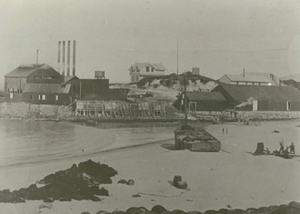
Erf 253 Plettenberg Bay – Beacon Island Drive
Compiled by Rodney Grosskopff
From time immemorial whales have visited this beautiful bay and nursed their calves out of the cold west wind. Before men tread these beaches, the biggest creatures who have ever lived on the blue planet we call Earth and home have floated by on one side, waving a fin to whoever is out there in a lazy roll or pirouetting, tail on high, and then coming down with a slap or just exhaling with a spray to let you know that they are there.
Where the great whales come sailing bye,
Sail, sail, with unshut eye,
Round the world for ever and for aye.
All those who saw them then, and still do so now, gaze with wonder and relax in the joy they bring.
The establishment of the whaling industry in the Cape of Good Hope was impeded by the American War of Independence. The control of the Cape changed five times and this impacted on the development of its infrastructure.
A Dutch company founded the Southern Whale Fishery and operated it for about a year. Then the French landed in Cape Town with “3000 troops to assist the Governor,” and it became very difficult for the company to export goods and it eventually cessed to operate.
In 1795, Elphinstone took over the Cape for Britain ‘to hold it in Trust for Prince William of Orange’. In 1797, an enterprising merchant, one John Murray, bought the company and, in effect, controlled the whale catches from Mossel Bay to Algoa Bay. It was said that in one season, Murray caught between 15 and 30 whales in Mossel Bay.
In 1802, the Cape was handed back to the Batavian Republic. A charter from the new government granted three Dutch merchants, Van Hull, Sappe, and Muntingh, the exclusive right to hunt whales around the Cape coast. It also insisted that John Murray “is obliged to desist from fishing”. The Dutch Company forced Murray to accept 23 shares for his company in this new venture. In 1805, “they caught 11 whales on the Southern Coast of the Colony”.
On 6 January 1806, a British force landed in Table Bay and reclaimed the Cape for Britain. Relevant to our Plettenberg Bay story, Captain Robert Harker became the representative of the British Government.
The entrance of John Archibald Sinclair opened the second chapter of Plettenberg Bay’s whaling story. He was a Scot, born in Greenock, and he captained a brig called Calypso for Chiappini and Company in Cape Town and traded and transported up and down the coast for them. He also had whaling experience in the northern hemisphere. He became attracted to Plettenberg Bay for a few reasons: he was friendly with Captain Robert Harker, the government agent who had persuaded him to move here; there were many whales and, not least, he had fallen in love with Harker’s daughter, Julia Maria.
He persuaded his company to form the Whale Fishery in Plettenberg Bay,
with him as a partner and the local representative. Although he proposed to Julia Maria, Robert Harker would only give his permission for Sinclair to marry once he had caught his first Right Whale. This he did and he married on 25 November 1832.
By all accounts, the venture was quite successful because through the lean times seals were hunted. Harker ensured, however, that a viable population of seals was maintained on Seal Mountain. During the off season, he also traded in in wood and any goods that were in demand. Sinclair was worth £10,000 by the time he died in 1859 so he must have been quite prosperous. Very little is known about Captain Jeffries, his successor.
The next chapter starts with the English settlers. In 1847, William Henry Newdigate arrived in Plettenberg bay and launched a campaign to recruit English settlers to populate Plettenberg Bay. Names that still linger in many families here include Noble, Derbyshire, Toplis, Jones, Sewell, Watson and Mc Cullum.
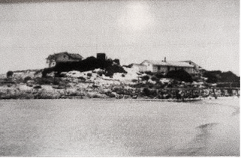
The island before 1900.
Percy Toplis, the son of Aaron Toplis and one of those pioneers, secured a whaling lease on Beacon Island and teamed up with Cornelius Watson, a legend among local fishermen, to restart the whaling industry. Our record of their activities comes from notes recorded by others.
The first of those notes was addressed to Aaron Toplis:
“Sir,” it reads, “Hoping you are well. I haven had any time to come to see you. Since I had the last whale. The two whales gives us about three thousand gallons of oil, more or lest, and bone between 1200 and 1300 lbs.
I will be able to let you know later when I sending it away. I also sending you the list of fish —two months fish. Please sent my articles down bye the Bearer as I like to have them.
Yours
C.Watson.”
Captain John Fisher Sewell, the Harbour Master confirms in his year-end report of March 1896 that two Right Whales had been caught and 3000 gallons of oil and 1200lbs of whale bone had been sent away.
On 20 July 1899, when they were all in church, Willie Breach (often referred to as Dear Old Willie) was leading the service. Cornelis Watson sent word that there was a ‘big one’ in the Bay. The message was whispered from mouth to mouth and from pew to pew. Every time Willie turned his back on the church, another whaler would slip away. There were two boats and each needed a whaler and four rowers. When they had gathered the crew, they hurried down Puff Adder Alley through the forest to the beach and launched their boats.
I can only imagine what Willie must have thought, but being the gentleman that he was, he said nothing. He knew that in recent years the pickings had been small. The year before, there had only been one whale. That year, there had been none.
Watson, in his boat ‘Scorpion’, was out in front and set a ‘V’ course. It was hard work, but these were hard men of the sea. After a while, they cornered the whale and Watson records: “He harpooned it all right, and it pulled him right around the far side of Cape seal (Robberg).”
Angus Mc Callum, in charge of the second boat, records: “By the time we caught up it was already getting dark, all evening the whale pulled our boats backwards and forwards, inshore and off. Then at about 11o’clock Watson cut us adrift. Just after wards the whale dived. Watson’s light went out and we never saw him again.”
A week later a Right whale was washed up in Cape Town with our harpoon still in it. Three months later one plank with the name Scorpion painted on it, was found —–but nothing else, evermore.”
(The town folk had gathered on the Robberg and watched the tragedy unfold.)
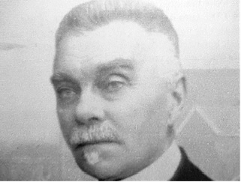
Ship owner, H.M . Wrangel
.
That hails the final chapter of our story. The Norwegians take over in what must have been a difficult and drawn-out negotiation. Thesen & Co of Knysna introduced the scheme to H. M. Wrangel, the Norwegian Consul and he brought the Hvalfangerseskabet Haral Haarfsgre Company from Norway on board. They floated a company with a share capital of 1.3 million kroner (£75 000) with H. M. Wrangel, as manager of the Harald Haarfsgre Company and Thesen, the local agents. Percy Toplis sold his valuable rights for £125.
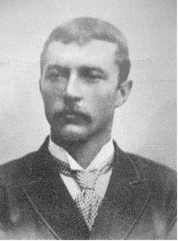
Captain Jacob Odland
.
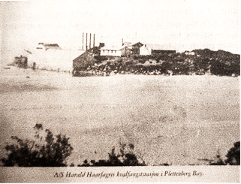
The new whaling station
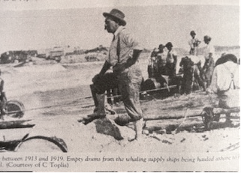
They started this ambitious project with two of their existing supply steamers S.S. Lesseps and S.S. Sigrun and a floating factory ship, the Haugerland, and 70 crew but immediately ordered seven whale catchers from Akers Mekaniskaversted, Christiana, at a cost of 800 000 kroner (£40 000). These vessels were appropriately renamed the Plettenberg, Knysna, Bitou, Formosa Goukama, Tzitzkama and Piesang. They built the shore station with the most modern whaling equipment for 600 000 kroner (£30 000).
Thesens, the designated agents who were to handle sales, provisioning, etc., arranged berthing the ships at the Knysna wharf.
On 26 December 1912, the Piesang was the first whaler to arrive. The other whalers, with Captain Jacob Odland, arrived in May 1913. Whaling now began in earnest.
Captain Odland, a strikingly good-looking man, was placed in charge. He endeared himself to the local residents and enjoyed nothing more than a good game of bridge. His men, all young and fair-headed, followed suit.
Their first season was a great success: 21 whales, 8,800 barrels of oil and 4 000 sacks of guano.
One of their men – C. M. Seur – drowned and their expenses started to climb. One of their whalers (the Formosa) ran aground in the Knysna Lagoon and the berthing of the whalers resulted in great confusion at the Knysna wharf .
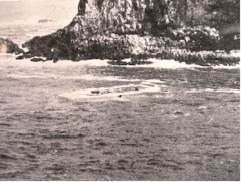
The Piesang keel-up at the Heads
The second year started off with much promise. A special wharf was constructed for the whale catchers in Knysna. However, in January 1914, the Captain pumped 2 000 barrels of oil into the S.S. Lesseps and things started to go wrong. There were objections to the berthing £2 charge. Goukama struck a sandbank at Featherbed Bay. Three months later, the Agnar, one of Thesen’s Coasters, collided and capsized the pilot boat at a time when four of the whalers were in the harbour taking on water and coal. The estuary was becoming congested.
When, in June, it was reported that there were 136 whales in the Bay, things began to look up. Then, on 15 July 1914, a terrible fire broke out and would have consumed the total installation on Beacon Island had it not been for the powerful pumps, which saved half of it. A month later, World War 1 broke out.
Three weeks after the outbreak of war, the Piesang was wrecked on the bar at the Knysna Heads and lay right across the entrance. A tug (Sir John) from Durban was brought but in but could not move the wreck. This was a dangerous situation and almost brought shipping to a halt. It was decided to blow up the wreck but before that could happen, the sea lent a hand and the waves smashed it up so that it could be taken apart and its equipment could be removed.
The war, however, dealt the final blow. In November 1915, at the end of the whaling season, Captain Odland returned to Norway to join his wife and discussed the closure of the operation.
Despite all the setbacks, the year had ended very well. The tanks on the beach contained 16 000 barrels of oil, which they could not move.
On 1 December 1916, the whaling station stopped working. The remaining whale catchers were sold off and the other equipment was sold off to the Union Whaling Company in Durban. (The tanks were floated and towed to Durban.) The company closed in 1976.
One cannot but feel a measure of sympathy for the Norwegian company. It was a well-established, equipped and staffed operation, but it made one miscalculation: thinking that it would work as a year-round industry. In essence, though, it was the war that closed it down.
Interestingly, without the closure of the whaling industry, Plettenberg Bay would have been a very different place. Central Beach would not have been one of the finest beaches in the country. Beacon Island would not be one of the most desirable of holiday destinations in the country. The Beacon Island Hotel, conceived by Sol Kersner and designed by Andre Hoffe in 1972, would not exist.
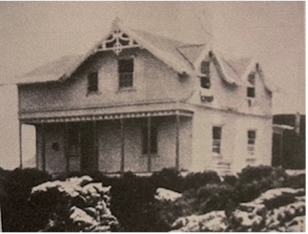
Captain Jacob Odland’s House brought from Norway.
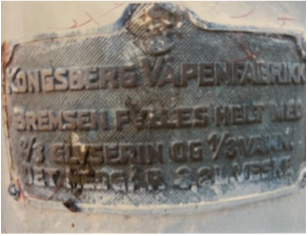
Makers insignia on harpoon
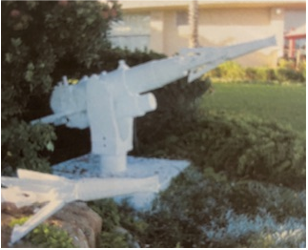
Piesang Whale Boat harpoon at Beacon Island
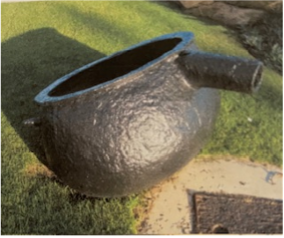
Cooking Pot for whale blubber
Bibliography
Kalleland, H. The Sinking of the D/Wh Piesang.
Storrar, P. 1978. Portrait of Plettenberg Bay. Cape Town: Centaur Publishers.