
St Michael’s Anglican Church, The Crags
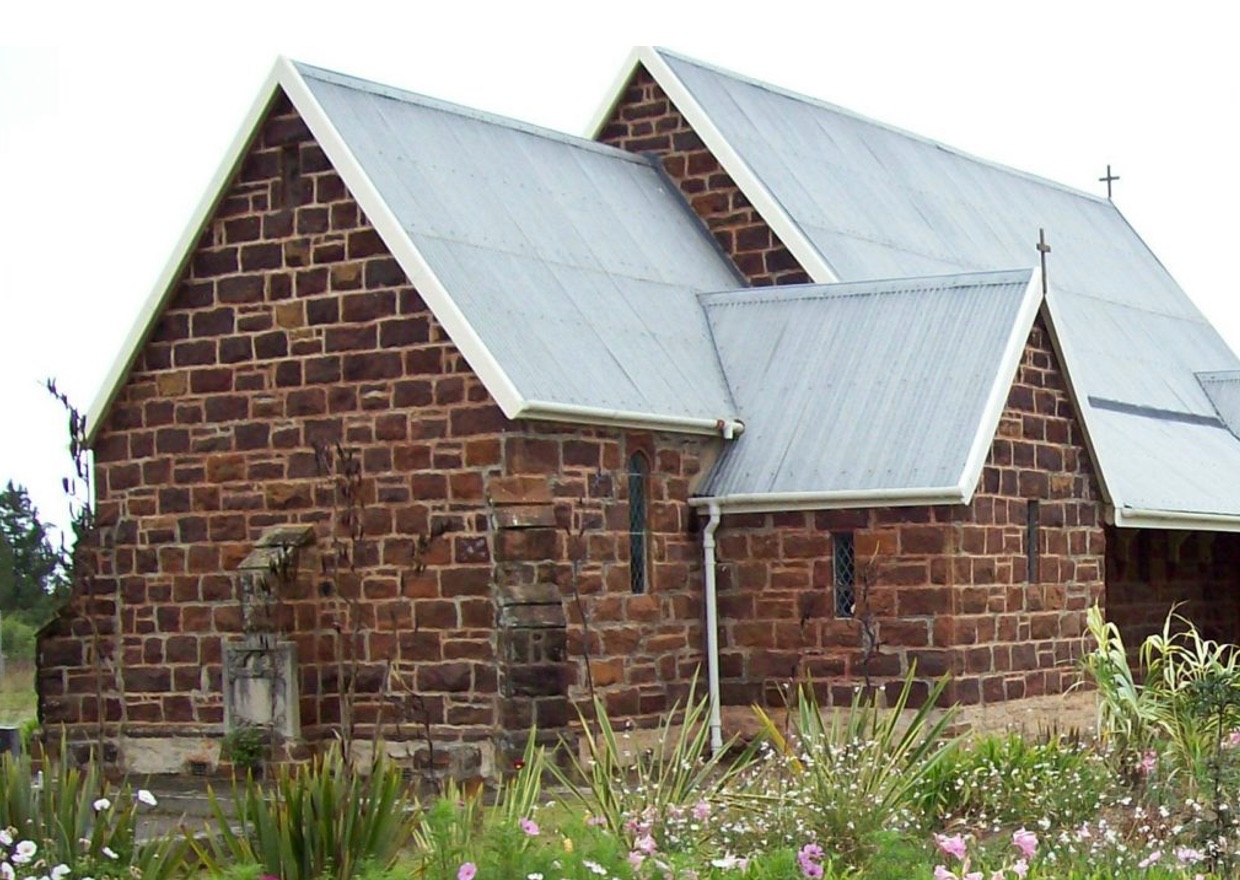
The Story of St Michael’s
By Rodney Grosskopff
The story of St Michael’s began in 1863. Bishop Robert Gray visited Plettenberg Bay to consecrate the new, temporary Mission Church for St Peters.
By this time, William Henry Newdigate had built his second home, ‘Forest Hall’ at the Craggs, and Robert Gray could not leave town without seeing his old friend. He and his wife, Sophy, went to spend a few days with Newdigate and his family at his grand new country seat and afterwards recorded that “the house was in the last part of his diocese and almost inaccessible.”
On Sunday morning, the bishop celebrated Holy Communion with forty people in the large dining room. This was quite extraordinary if you take into account that there were only 95 people living in the newly opened district and that it was quite a distance away. In fact, Newdigate met Bishop Gray and his wife at the Keurbooms River with fresh horses to enable them to complete their journey from Plettenberg Bay. I am sure that the congregation and friends might also have been enticed by the fact that they could see the grand new manor house!
The wily old Bishop Gray had an incredible vision for the church. During his time in South Africa, he was responsible, or partly responsible, for the building of 67 churches with his wife Sophy, designing 40 of them. He took the opportunity to persuade Newdigate to set aside some of his ground in Kurland to allow local Coloured folk to set up a village of their own and build a new church.
Newdigate donated the ground, but it was his family who fell in love with the project, and in particular, his two eldest daughters, Caroline Barbara and Constance Marion. They were determined to see it built. Even as young girls, they began to collect funds for its construction.
On their farm, they discovered a curious moth which had been identified as the extremely rare Leto Venus moth. Thomas Bain’s daughter, Georgina Lister, reminisces: “As coffee was being taken in the drawing room, there was a fluttering sound in a corner and a beautiful silver moth which had just emerged from its chrysalis flew around the room. It was nearly six inches from wingtip to wingtip and was coloured a soft pinky beige tint marked with lovely shiny spots and flashes of silver. Caroline explained to me that they brought the old logs which house the cocoons from the forest and preserved the moths.” The daughters began sending the moths to collectors and to museums around the world at 5/- each, and they also sent a pair to Mr A. Rothschild of 148 Piccadilly, London for 15/-.
After William Newdigate died in 1884, there was dissention in the family about the churches in Plettenberg Bay. This involved his wife Caroline, his brothers Francis and George, as well as his son Arthur. The dissention concerned several issues. The two existing churches, St Peter’s and St Andrew’s, were projects dear to William Henry Newdigate’s heart but they needed repairs. Caroline, on the other hand, wanted to build a new stone church as originally intended at Redbourn (St Andrew’s). The two eldest daughters wanted a new church at Kirbywood (the Crags today).
Finally, no doubt prompted by her daughters whose collection and sale of Leto Venus moths had already assembled a sizable sum, Caroline agreed. A substantial church could now be built at Kirbywood. The uncle and High Sheriff of Derby, Sir Francis William Newdigate, sent them plans.
The architect, however, is unknown.
The bishop was petitioned for the right to access the Plettenberg Bay Endowment Fund, the money raised by Francis Parker Newdigate, William’s Father. There was still £800, plus £84-17-4d interest and a further £35-18-11d. It was agreed that the necessary repairs to the other two churches should go ahead.
Work started on site but there were complications. In 1891, after serving his flock in Plettenberg Bay for 21 years, the Reverend Edwin Gibbs died two weeks before his 65th birthday. Rev Benjamin Mortimer of Knysna was told to ‘keep an eye on Plettenberg Bay’ so he sent his assistant, William Breach, as ‘Deacon in Charge’ to Plettenberg Bay.
Breach was a diffident fellow, with great charm and a love for his fellow man. His parishioners petitioned the diocese ‘to priest him as he is much beloved’ but William Breach believed that he would not pass the necessary examinations and was happy to remain ‘Deacon in Charge’. Whatever his title in the church, he came with great charm, love and more than his share of good common horse sense.
Breach was, however, thrown into the deep end. After 6 years, the building was scarcely more than the foundations. More than half of the total amount allocated to the project had been spent, i.e., £460 of £800. Breach felt that the plan was too ambitious for a ‘rustic church’ and suggested numerous changes to reduce the costs. He persuaded the bishop to increase the budget by a further £200 to complete the building. This new budget enabled Breach to build the church within the required timeframe. It was consecrated on 18 June 1905 by Archbishop William West-Jones. The font and pedestal were donated by Mr Spooner, the carved priest’s chair by Mrs Dreyer and the holy table and altar rails, etc. were also all donated. Members were appointed to high office in the diocese and it was visited by leaders of the church. The local Coloured village was developed and loved by its parishioners.
The parish had its share of interesting characters. Old Oom Hendrick Barnado kept his coffin made of stinkwood and yellowwood under his bed “ just in case “, which he proudly showed to anyone who visited. Unfortunately, he loaned it to a friend a week before he died. They found a replacement in Coldstream but the problem was transport. Thankfully, someone knew someone with a bright yellow station wagon. And so it came about, as reported by Patricia Storrar, “That Hendrik Bernado, overseer of convicts, hunter, tracker farmer and (in a mild way) property developer, was driven to his final resting place not only in the gayest of hearses, but by surely one of the most distinguished hearse-drivers, Brigadier Sir Henry Scott K,C,B., D,S,O., M,C.” which was a tribute to his popularity.
Hendrik is still seen walking at dusk on a summer’s evening through the gardens of Natures Valley with a dignified tread, hat on his head, stick in hand, reminding the children and grandchildren that this was once the land he farmed, his native lands.
Bibliography
A Guide to St Peter’s (out of print).
Church files on the purchase and raising of funds by the Wheeldon family,
original letters and some drawings
Dunn, L. Papers and discussions
Martin, D. 2005. The Bishop’s Churches. Cape Town: Struik.
Milburn-Pyle, P. 2006. Upon this Rock. 125th Anniversary pamphlet.
National Geographic New York. 2016. The Story of Jesus.
Storrar, P. 1978. Pamphlet on St Andrew’s.
Storrar, P. 1978. Portrait of Plettenberg Bay. Cape Town: Centaur Publishers.
Storrar, P. 2001. The Paradise Coast. Johannesburg: TYM Publishing.
The Formosan Magazine, April 2019.
